
 Ilan Asseo
What Is a Sales Qualified Lead? Examples and Benchmarks
Complete sales qualified lead definition with channel-specific criteria, concrete SQL examples, benchmarks, and a 30-day alignment plan.

A sales qualified lead, often shortened to SQL, is a contact who fits your ideal customer profile and has demonstrated clear buying intent that a sales rep has validated. It sits after marketing qualification and sales acceptance, and before an opportunity is created. In practical terms, an SQL is someone your team agrees is worth spending selling time on now, not later.
Why this matters: strong SQL definitions protect your calendar, improve forecast quality, and raise meeting win rates. When your team runs LinkedIn-first motions, the fastest and most reliable SQL signals often appear inside message threads. Capturing and standardizing those signals, then enforcing stage criteria and SLAs, is how you keep pipeline healthy at scale.
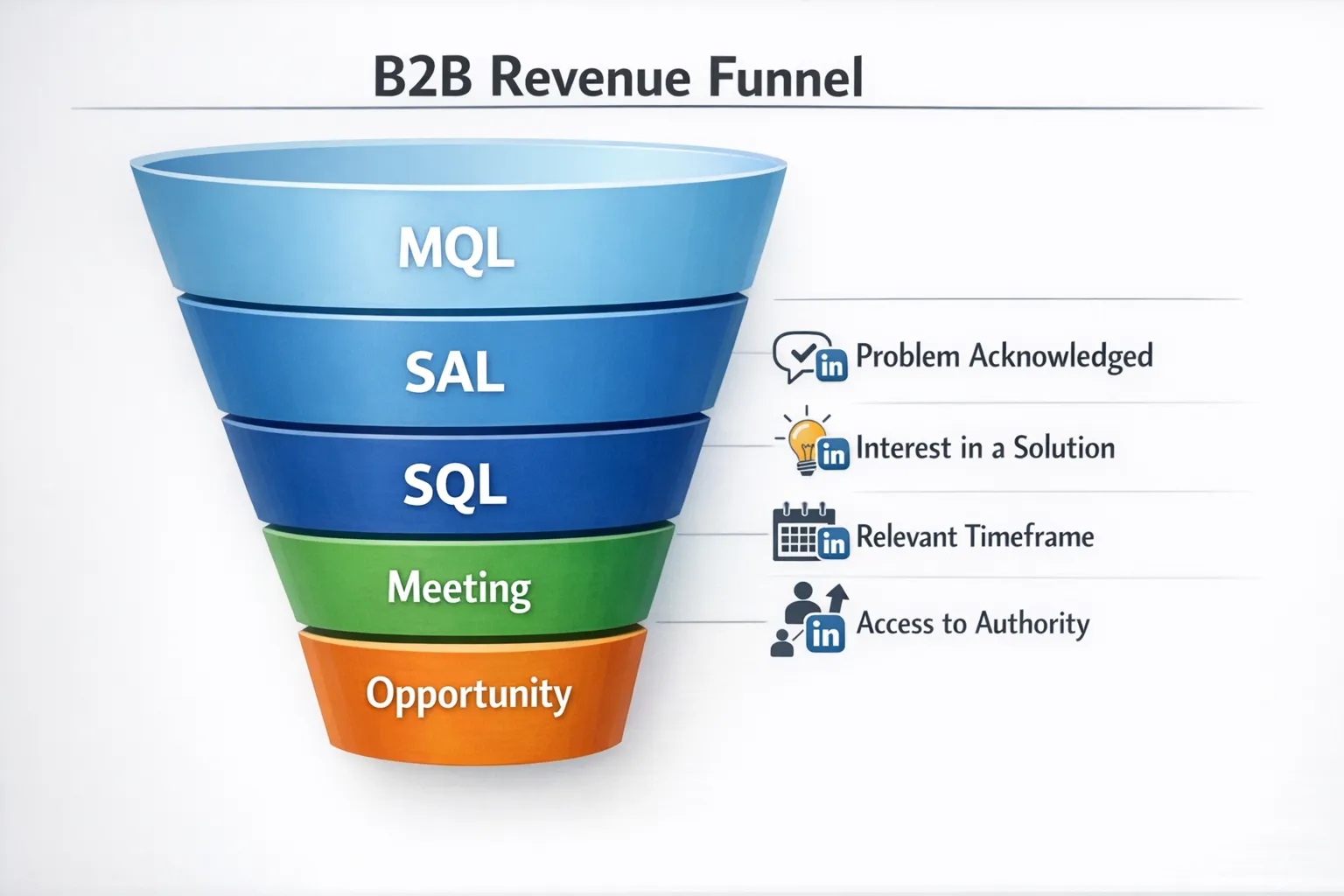
Industry evidence: Gartner’s research on the B2B buying journey shows that consensus creation is now a core buying job, which is why qualification needs buying-group evidence rather than single-contact activity.
Source: Gartner
SQL vs MQL, SAL, and SQO
- MQL: contact shows marketing-level engagement or fit, for example a demo request, content download, or high lead score.
- SAL: sales accepted lead, the handoff is reviewed by sales and accepted for outreach.
- SQL: sales validated fit and intent through a live conversation or equivalent explicit signal, and a next step is agreed.
- SQO: sales qualified opportunity, the account and contact are created as an opportunity in your CRM with a documented evaluation.
If your org uses both SQL and SQO, keep the distinction clean. SQL is a person-level validation of fit and intent, while SQO is the record that begins pipeline governance.
For deeper stage alignment guidance, see Kakiyo’s post on MQLs and SQLs: Align Definitions, Boost Pipeline Health.
What qualifies as an SQL in 2025
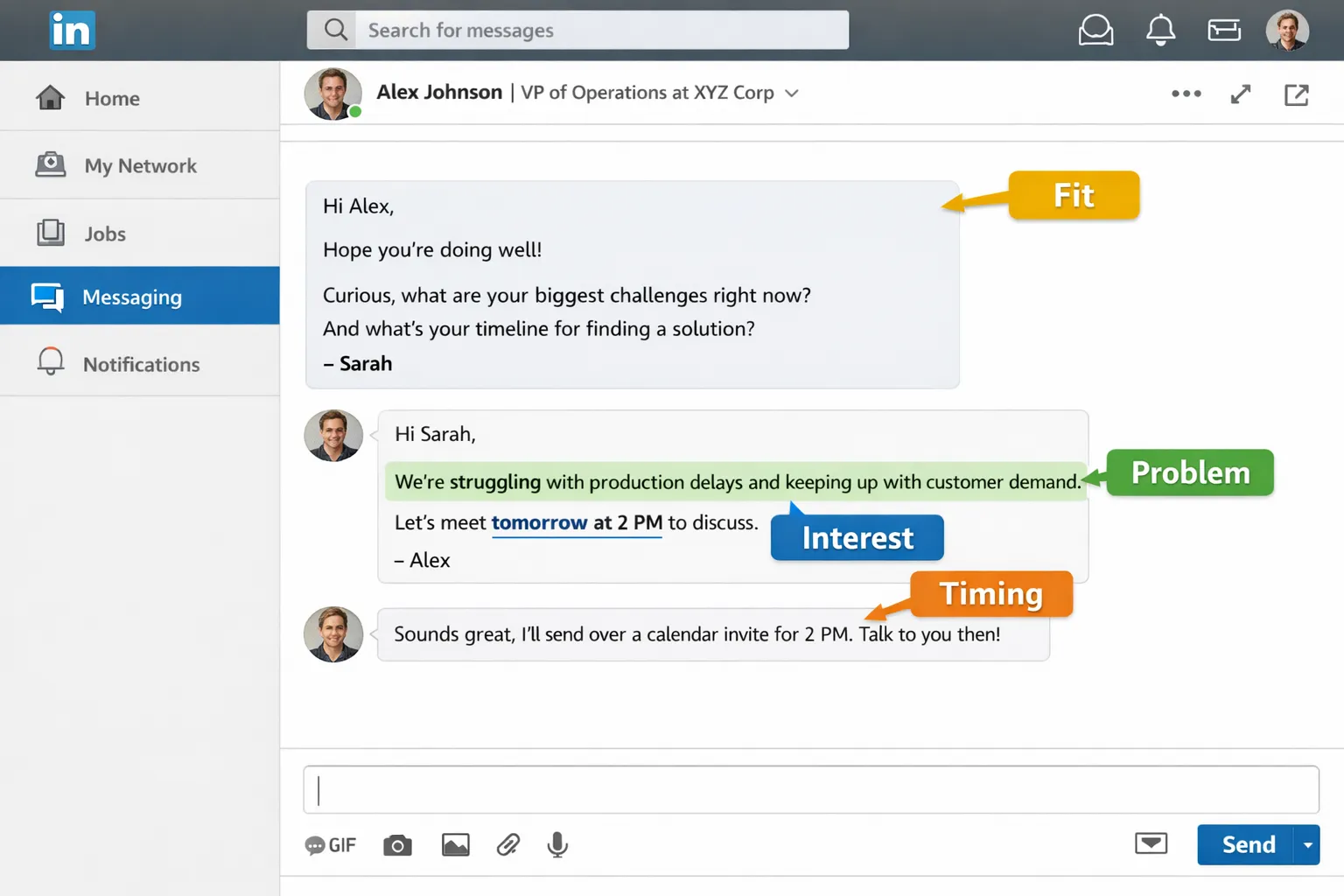
Every motion should use channel-appropriate evidence. As a baseline, require these four signals before you apply the SQL stage:
- Fit: the contact matches ICP by role, company type, size, or tech stack.
- Problem: they acknowledge a problem or goal your product addresses.
- Interest: they express interest in exploring solutions, a meeting, or a scoped next step.
- Next step with timing: you secure a scheduled meeting, a committed call-back time, or a mutually agreed evaluation window.
Channel-by-channel SQL criteria
| Motion | Minimum evidence for SQL | Owner at SQL | Next step |
|---|---|---|---|
| Inbound demo/request | ICP fit, demo sought by contact, confirms current challenge and meeting time | SDR or AE, depends on routing | Demo booked or discovery call scheduled |
| Outbound LinkedIn | ICP fit, problem acknowledged in-thread, interest in learning how you solve it, agrees to a time window for a call | SDR | Calendar invite sent, confirmation message shared |
| PLG or free trial | ICP fit, active usage or trigger threshold met, buyer confirms problem-to-solve and timeline to evaluate paid | Growth SDR or AE | Evaluation call booked, success criteria captured |
| Event or partner referral | ICP fit, context from event or partner, buyer asks to explore next steps within a timeframe | SDR or AE | Discovery booked with agenda |
For conversation-led motions, “interest” should be explicit in the transcript, not inferred from a click or view.
Concrete examples of SQLs (and why they count)
Example 1, outbound LinkedIn to a Sales Operations Director:
- Prospect: We need to increase meetings without adding headcount next quarter, so yes, interested in how you automate the early back-and-forth.
- Rep: If we can walk through 2 plays and show bookings from LinkedIn threads, would a 20 minute session Tuesday or Wednesday work?
- Prospect: Wednesday morning works, send an invite for 10:30.
- Why this is SQL: ICP role, stated problem, explicit interest, scheduled time.
Example 2, inbound demo from a Head of Marketing at a 200-person SaaS company:
- Prospect: Downloaded your LinkedIn playbook and want a demo. We are ramping 5 SDRs in January and need qualification in-thread.
- Rep: Great, we typically show how teams score conversations and book meetings without over-messaging. Would tomorrow at 2 pm be okay?
- Prospect: Yes, send it over.
- Why this is SQL: Clear fit and intent, near-term project, meeting secured.
Example 3, PLG trigger with buyer confirmation:
- System: Team invited 11 users, 3 sequences published in 7 days.
- Rep: I saw your team piloting the outreach templates. If improving qualified meeting rate is a Q1 priority, can we review what worked and what blocked scaling?
- Prospect: Yes, we want to standardize scoring and guardrails before we expand seats. Can we meet next Thursday?
- Why this is SQL: Usage trigger plus explicit business objective and agreed evaluation meeting.
Non-examples to keep quality high
- Curious student or competitor asking for pricing without problem context.
- Wrong ICP, for example a role that cannot influence your category.
- Generic interest without a next step, for example “send materials” with no time commitment.
How to write an SQL rubric your team can apply in seconds
Create one rubric per motion, and make it observable from conversation data. Here is a simple pattern that works well on LinkedIn:
- Fit signals to capture: title, department, company size or segment, relevant tech signals.
- Intent signals to capture: problem statement in their words, outcomes they want, interest language like explore, evaluate, compare.
- Timing and next step: meeting date, event or project anchor like QBR, renewal, funding.
- Authority path: the person’s role in the buying group or who they will bring.
Instrument these as checkbox or picklist fields, then write the SQL rule as: Fit is true, intent is true, and next step is scheduled within 30 days, authority is direct or a named path exists. If your CRM supports it, use a workflow or validation rule so the SQL stage cannot be set without the fields populated. If you work in Salesforce, lead scoring and stage rules can be supported by features like Einstein Lead Scoring and validation policies, see Salesforce’s Einstein Lead Scoring overview for implementation details.
For a step-by-step qualification system beyond SQL, read Kakiyo’s guide on the Lead Qualification Process: Steps, Scoring, and Automation.
Benchmarks: reasonable starting targets to calibrate against
Benchmarks vary by ACV, motion, and list quality, so treat the ranges below as directional starting points. Use them to size your funnel, then replace with your own 90-day rolling medians.
| Metric | Inbound | Outbound LinkedIn | Events/Partners | PLG |
|---|---|---|---|---|
| Speed to first touch SLA | 5 to 15 minutes | Same business day | 1 business day | Within 24 hours of trigger |
| SAL to SQL rate | 60% to 85% | 25% to 45% | 30% to 50% | 40% to 60% |
| SQL to meeting booked | 60% to 85% | 40% to 60% | 50% to 70% | 55% to 75% |
| Meeting hold rate (show rate) | 75% to 90% | 60% to 80% | 70% to 85% | 70% to 85% |
| SQL to opportunity created | 40% to 70% | 20% to 45% | 30% to 55% | 35% to 60% |
Notes that help these numbers hold up in the real world:
- Speed to lead matters. Responding within an hour dramatically improves contact and qualification likelihood. See Harvard Business Review’s analysis in “The Short Life of Online Sales Leads” for the durable principle that fast follow-up raises conversion odds, even if your channels have evolved from phone to LinkedIn and chat [source: Harvard Business Review].
- Align SQL with your opportunity criteria. If you only open opportunities after discovery, your SQL to opportunity rate will be lower and slower. If you open opportunities when a first meeting is held, it will be higher by definition. Keep your definitions consistent across quarters.
For broader funnel context, the Forrester Demand Unit Waterfall remains a useful mental model for standardizing stage names and handoffs across teams [source: Forrester].
Measuring SQL quality with precision and recall
Precision and recall help you evaluate whether your SQL rule is too loose or too tight.
- Precision: of the contacts you marked as SQL, what percent became meetings or opportunities within a defined time window. If precision is low, your rule is inflating the stage.
- Recall: of the contacts that should have been SQLs based on outcomes, what percent did you actually tag. If recall is low, you are missing deals.
Target a balance where precision is greater than 70 percent for inbound and greater than 60 percent for outbound to avoid clogging calendars, then tune recall up without sacrificing precision. Create a monthly spot-check of 25 random SQLs per channel and review the chat or call transcript to ensure your rubric was applied.
Making SQL explicit in LinkedIn conversations
LinkedIn threads are rich with intent signals. Build simple, thread-safe prompts for your team so you capture those signals without turning a conversation into an interrogation. Use open questions that are easy to answer in a sentence.
- Problem: When you think about raising meetings next quarter, what is the hardest part right now, list quality or capacity to run more quality conversations.
- Impact: If you solve that, how would you measure success, meetings per rep or opportunity creation.
- Timing: Would a quick review next week help you decide if this fits your plan for January.
- Authority path: Who else should join so we can make the session useful.
If you want examples of how to move from first touch to demo on LinkedIn without over-messaging your market, see the LinkedIn Prospecting Playbook.
A 30-day plan to set and stabilize SQL
Week 1, define: write motion-specific SQL criteria, document the exact fields required, and agree on SLAs. Add a short list of rejection reasons, for example wrong ICP, no project this quarter, competitor locked in.
Week 2, instrument: add the fields and validation rules in CRM, connect conversation capture from LinkedIn, and ensure your dashboard shows SAL, SQL, meeting, and opportunity counts with conversion and time deltas.
Week 3, baseline: pull the last 90 days by channel, backfill SQL where evidence exists, and calculate your initial conversion rates and show rates. Compare to the directional benchmarks above.
Week 4, enable: train SDRs and AEs on the rubric with 10 example threads per channel, then start a weekly calibration session to review edge cases. Publish the SLA clock and hold time-by-stage visible to the team.
If you want a deeper operating model for conversation-led qualification, visit Kakiyo’s post on AI SDR: Automate Conversations, Qualify Faster, Book More.
How Kakiyo helps teams hit higher SQL precision on LinkedIn
Kakiyo runs personalized LinkedIn conversations at scale and captures the evidence you need to mark SQL with confidence. Teams use the platform to:
- Autonomously manage respectful, 1-to-1 LinkedIn conversations from first touch through qualification.
- Apply AI-driven lead qualification that looks for your rubric signals and scores each thread.
- Create and A/B test prompts and industry-specific templates to raise response and qualified rates.
- Score contacts with an intelligent system that factors fit, intent, and timing from the transcript.
- Manage many simultaneous conversations while keeping conversation override control for reps.
- Monitor a centralized real-time dashboard with advanced analytics and reporting so you can compare SAL to SQL to meeting across lists, cadences, and segments.
Because the evidence is in the message history, Kakiyo makes it simple to standardize how SQL is decided without turning your motion into a script. To see it in action, start at kakiyo.com.
Additional resources and references
- HubSpot overview of sales qualified leads, helpful for baseline definitions and examples source: [HubSpot].
- MEDDICC, a popular enterprise qualification framework for discovery and opportunity stages [source: MEDDICC].
- LinkedIn State of Sales research for modern buying behavior and social selling context [source: LinkedIn Sales Solutions].
- Forrester’s Demand Unit Waterfall for standard stage naming and alignment across teams [source: Forrester].
- The Bridge Group SDR research and metrics for prospecting motions and meeting production trends [source: The Bridge Group].
If you are aligning marketing and sales on MQL, SAL, SQL, and SQO handoffs right now, you will likely also benefit from Kakiyo’s deep dives on Automated LinkedIn Outreach and the Lead Qualification Process. With clear SQL criteria and conversation-level evidence, your team can protect calendars, improve meeting quality, and create more predictable pipeline.
FAQ
What is the difference between a lead and a qualified prospect?
A lead is simply a potential contact or account. A qualified prospect has enough verified fit, intent, and context to justify a next sales step.
What makes qualification trustworthy?
Qualification is trustworthy when it relies on auditable signals, not labels alone. The more evidence a team can verify, the easier it is to align sales, marketing, and RevOps.
Should qualification be based on one score?
Not by itself. Scores are useful summaries, but teams still need explicit criteria around fit, buying signals, and next-step readiness.
How do I implement proof-based qualification in my team?
Start by defining what evidence is required at each stage, then make those signals visible in your workflows. The goal is consistency across inbound, outbound, and partner-sourced leads.