
 Ilan Asseo
Lead Qualification Process: Steps, Scoring, and Automation
Step-by-step lead qualification process with a Fit, Intent, and Conversation scoring model plus an automation blueprint for consistent results.

If your team treats lead qualification as a one-time form check, you are leaving pipeline and productivity on the table. In 2025, the highest performing revenue teams qualify continuously, not just at handoff. They combine a crisp process, a transparent scoring model, and automation that captures intent signals from every interaction, including live conversations on LinkedIn. The result is faster routing, cleaner meetings, and SDRs who spend time where it matters.
Below is a step-by-step lead qualification process you can deploy, a practical scoring framework you can adapt, and an automation blueprint that turns good definitions into consistent outcomes.
Industry evidence: Gartner’s research on the B2B buying journey shows that consensus creation is now a core buying job, which is why qualification needs buying-group evidence rather than single-contact activity.
Source: Gartner
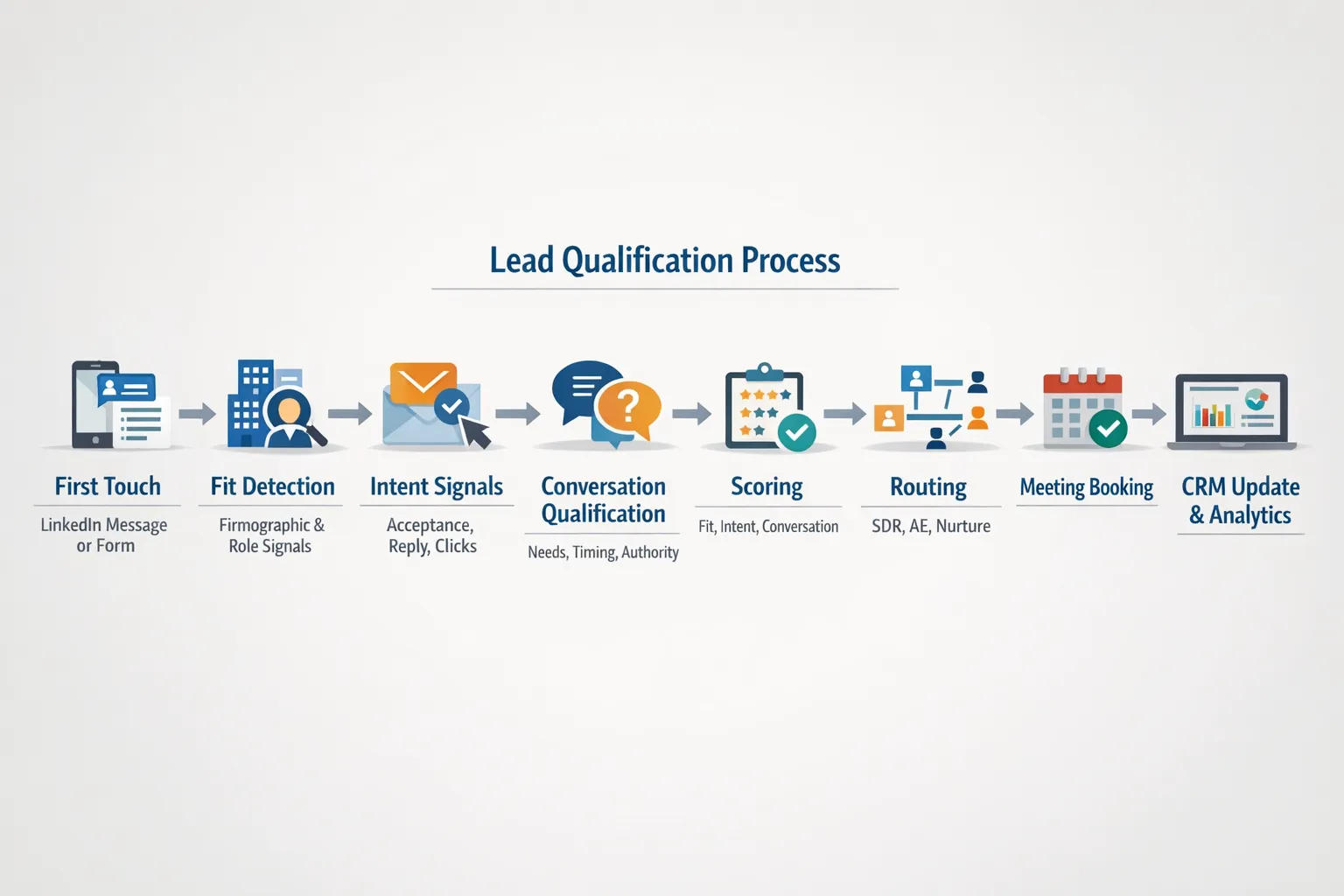
The modern lead qualification process, end to end
- Define ICP and disqualifiers: Document company attributes you sell to, buyer roles, regions, and red flags to exclude. Align with marketing and sales leadership so fit criteria are not debated later.
- Standardize lead stages and SLAs: Make Inquiry, MQL, SAL, SQL and Opportunity operational with clear entry and exit criteria, owners, and response-time targets. If you need a refresher on stage alignment, see Kakiyo’s guide on MQLs and SQLs.
- Capture first-touch context: Keep forms minimal and rely on enrichment, intent data, and public profile signals. On LinkedIn, start with permission-based invites and short openers that reference a relevant trigger.
- Detect fit automatically: Use data enrichment and profile parsing to score company size, industry, geo, tech stack, and buyer role. Apply negative scoring for clear mismatches.
- Read intent in real time: Track micro-conversions such as connection acceptance, first reply, content engagement, website visits, and meeting-page views. Map these to a consistent intent score.
- Qualify in the conversation: Ask one question at a time, progress logically, and log structured answers. Favor buyer-led language instead of rigid scripts.
- Score and route: Blend Fit, Intent, and Conversation signals into a single score with explainability. Tie thresholds to actions and SLAs.
- Book and hand off cleanly: Offer calendar options, confirm purpose and agenda, and include key details discovered in-thread so the AE or founder walks into a higher-probability meeting.
- Close the loop with analytics: Monitor conversion by score band, explainability of scores, and time to first touch and to meeting. Feed learnings back into prompts, routing rules, and content.
A practical scoring model you can adapt
A transparent scoring model prevents gaming, builds trust, and makes continuous improvement possible. Keep it simple, explainable, and tied to observable evidence.
- Fit score, 0 to 40: Who they are. Company and contact attributes that match your ICP.
- Intent score, 0 to 30: What they do. Behavioral signals that suggest interest right now.
- Conversation score, 0 to 30: What they say. Explicit needs, timing, authority, or referral captured in-thread.
Example attributes and points
| Score type | Attribute | Example criteria | Points (example) | Notes |
|---|---|---|---|---|
| Fit | Company size | 50 to 1,000 employees | +10 | Adjust to your sweet spot |
| Fit | Industry | Targeted verticals | +8 | Add negative points for excluded sectors |
| Fit | Buyer role | Director, VP, C-level in target function | +12 | Use title and seniority signals |
| Fit | Region | Supported sales territory | +6 | Zero or negative if unsupported |
| Fit | Tech stack | Uses a complementary tool | +4 | Negative if clear conflict |
| Intent | LinkedIn acceptance | Connection accepted within 3 days | +6 | Signal of openness |
| Intent | First reply | Replies to opener | +10 | Score varies by sentiment |
| Intent | High-intent action | Visits pricing or books via link | +12 | Use tracked events where available |
| Conversation | Need articulated | Mentions current pain or goal | +8 | Extract key phrase or tag |
| Conversation | Authority or referral | Self identifies as decision maker or refers you to one | +10 | Referral carries points too |
| Conversation | Timing | Project within 90 days | +12 | Adjust for your sales cycle |
This is a template. Your actual weights should be tuned to historical data, then validated through A/B tests and ongoing calibration. If you use CRM-native scoring, keep custom fields and picklists standardized so scores remain explainable to reps.
From scores to actions
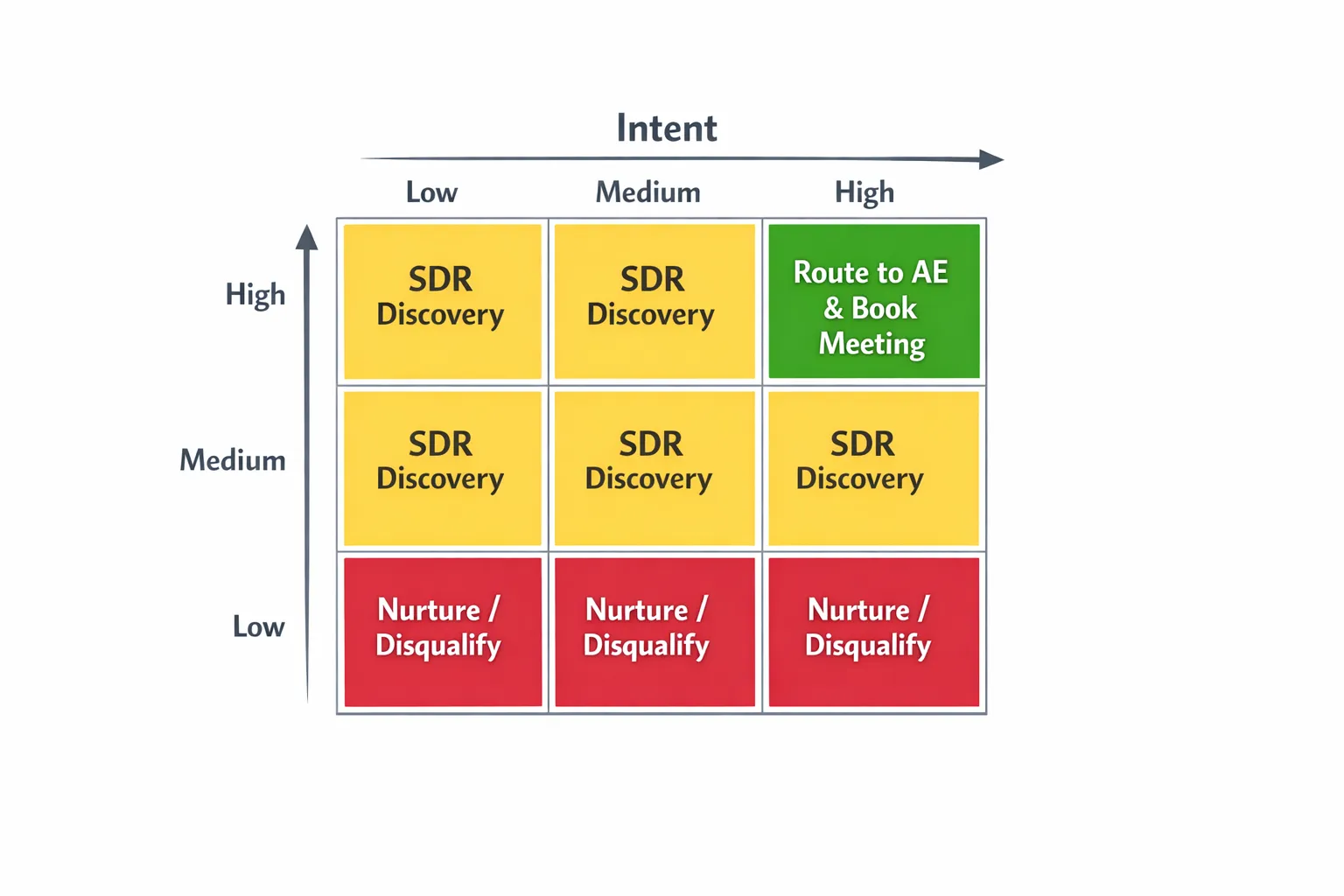
Tie score bands to clear, automated actions. Give reps and managers a one-line rule they can remember.
| Total score | Evidence snapshot | Action | SLA | Owner |
|---|---|---|---|---|
| 70 to 100 | Strong fit, active intent, explicit need or timing | Route to AE and offer meeting times | 2 hours | SDR books or AI books directly |
| 50 to 69 | Good fit, positive engagement, partial qualification | SDR to continue discovery, then book | Same day | SDR |
| 30 to 49 | Moderate fit or weak intent | Add to nurture, re-engage later with signal-based prompt | 24 hours | SDR or marketing |
| 0 to 29 | Clear mismatch or opt-out | Disqualify with reason, stop outreach | Immediate | System with human override |
Make the disqualification reasons explicit and reportable, for example no ICP, student/agency/vendor, wrong geo, competitor-only stack, opted out.
Conversation-led qualification on LinkedIn
Frameworks like BANT, MEDDICC, and SPICED are useful, but the medium is the message. In a social conversation, ask one small question at a time, and never force a prospect through a rigid checklist. Here is a lightweight, thread-friendly flow you can adapt.
- Context: We work with [peer example] to reduce [cost, time, risk] in [function]. Does that resonate in your world right now?
- Pain or priority: If yes, what is most painful today, workflow, cost, compliance, bandwidth?
- Impact: If you solved that, what would it unlock, time back for AEs, better conversion, less manual work?
- Timing: Is this on your radar this quarter or is it exploratory for later in the year?
- Decision path: Who else usually evaluates tools like this on your side, and what do they care about most?
- Next step: If this is worth 20 minutes, happy to send times or work around your calendar.
Keep language human, acknowledge objections, and gracefully exit when the fit is not there. Disposition the thread anyway, because clean negatives improve your scoring model and future routing.
Automation blueprint: turn definitions into outcomes
Automation should respect buyer experience, comply with platform rules, and keep humans in control. When done correctly, it removes lag and busywork without losing quality.
- Triggering: Fire workflows on first touch, threshold score changes, or specific conversation tags such as authority, timing, objection.
- Routing: Assign owners based on territory, account status, or score band. Keep queues small and visible.
- Meeting booking: Offer calendar links only after positive intent, and set expectations, time box, agenda, who should join.
- Follow-up cadences: Automate smart nudges if a prospect pauses, for example a 5 day bump that references the last message, not a generic bump.
- Negative outcomes: Stop sequences and log disqualification reason immediately on opt-out or mismatch.
- Explainability: Surface why a lead scored high, for example role, reply sentiment, timing within 90 days, so reps trust the automation.
- Testing and governance: A/B test prompts, opening lines, and CTAs. Keep a change log for prompts and routing rules.
For policy and buyer experience, read the LinkedIn Professional Community Policies. Stay permission-based, pace activity reasonably, and respect do-not-contact.
Metrics that prove your qualification works
Track leading and lagging indicators by source, segment, and score band. Hold yourself accountable to speed and quality.
| Metric | Type | Why it matters |
|---|---|---|
| Connection acceptance rate | Leading | Indicates audience quality and opener relevance |
| First reply rate | Leading | Signals message-market fit by segment |
| Qualified conversation rate | Leading | Measures how often context turns into explicit needs |
| Meeting booked rate | Lagging | Core output of qualification quality |
| Show rate and next stage rate | Lagging | Validates meeting quality and handoff |
| Time to first touch and to meeting | Process | Quantifies automation impact on speed |
| Pipeline and revenue by score band | Outcome | Confirms that scoring separates signal from noise |
| Opt-out and complaint rate | Safety | Protects brand and channel access |
Aim to review these weekly during rollout, then biweekly. Calibrate score thresholds if you see too many no-shows or low conversion in the top band, or if good opportunities are stuck in mid bands.
Common pitfalls and how to avoid them
- Overfitting scores to one channel: Balance web, email, and social signals. Give conversation evidence appropriate weight.
- Hidden negative signals: Add negative points for student, recruiter, agency, or non-target regions, not just positive points for good fit.
- Score opacity: If reps cannot see why a score is high, they will ignore it. Show the top three contributing factors.
- Scripted interrogation: On LinkedIn, long qualification checklists read like a survey. Ask one thoughtful question at a time.
- Manual logging debt: If answers stay in the message history, your forecasting and routing will miss them. Automate tagging of key replies where possible.
- Inconsistent disqualification: Require a disposition reason and audit it. Clean negatives raise trust in the whole model.
Where automation and AI raise the bar
Modern AI can manage personalized conversations at scale, qualify prospects in-thread, and book meetings while keeping humans in control. For teams running LinkedIn as a core outbound and ABM channel, Kakiyo was built for this motion.
How Kakiyo supports the process described above:
- Autonomous LinkedIn conversations: Start, sustain, and progress context-aware threads with prospects at scale, from opener to booking.
- AI-driven lead qualification: Ask smart follow-ups, extract needs, authority, and timing signals, and tag them consistently.
- Intelligent scoring system: Score Fit, Intent, and Conversation signals in real time so routing and booking can happen without lag.
- Customizable prompt creation and A/B prompt testing: Encode your positioning and value hypotheses, then test variants to improve acceptance, replies, and qualified conversation rate.
- Industry-specific templates: Start with patterns that already reflect your buyer’s language and priorities.
- Simultaneous conversation management with conversation override control: Let AI handle volume while SDRs jump in instantly for high-value moments or sensitive accounts.
- Centralized real-time dashboard with advanced analytics and reporting: Track leading indicators, meetings, and score distribution across teams and segments.
If you want a deeper playbook for prospecting on the same channel, read the LinkedIn Prospecting Playbook. For teams tuning CRM-based scores, see Salesforce and HubSpot’s primers on lead scoring, for example Salesforce’s guide to lead scoring and HubSpot’s overview.
Implementation plan, 30 days to impact
Week 1, definitions and data: Finalize ICP and disqualifiers, map stages and SLAs, list Fit and Intent attributes you can observe today, pick five conversation tags you must capture.
Week 2, scoring and prompts: Stand up a simple 40, 30, 30 scoring model, write two opener variants and three follow-up questions aligned to your ICP’s top pains, define routing thresholds.
Week 3, pilot and calibration: Run a contained pilot on one segment, instrument acceptance, reply, qualified conversation, booking and show rates by score band, adjust weights if top band underperforms.
Week 4, automate and scale: Turn on routing, booking offers, and nurture for mid-band leads, add guardrails and override rules, publish a one-page playbook and hold a short enablement session.
Final thoughts
Great qualification is not a checklist, it is a system. When your steps, scoring, and automation reinforce each other, you convert more first touches into meetings without burning trust. If you are ready to operationalize conversation-led qualification on LinkedIn with real-time scoring and human-in-the-loop controls, take a closer look at Kakiyo at kakiyo.com.
FAQ
What is the difference between a lead and a qualified prospect?
A lead is simply a potential contact or account. A qualified prospect has enough verified fit, intent, and context to justify a next sales step.
What makes qualification trustworthy?
Qualification is trustworthy when it relies on auditable signals, not labels alone. The more evidence a team can verify, the easier it is to align sales, marketing, and RevOps.
Should qualification be based on one score?
Not by itself. Scores are useful summaries, but teams still need explicit criteria around fit, buying signals, and next-step readiness.
How do I implement proof-based qualification in my team?
Start by defining what evidence is required at each stage, then make those signals visible in your workflows. The goal is consistency across inbound, outbound, and partner-sourced leads.