
 Ilan Asseo
Cold Outreach Examples: High-Reply Templates for 2025
Field-tested cold outreach examples for LinkedIn and email that earn replies in 2025, with personalization tips and A/B testing guidance.

Most cold outreach advice is theory. In 2025, you need copy that earns replies, not longer threads. Below is a field-tested set of short, buyer-first templates you can paste into LinkedIn and email, plus guidance on when to use each, how to personalize quickly, and how to A/B test without burning your market.
Industry evidence: “As customers increasingly learn and buy digitally, sales reps become just one of many possible sales channels.” — Cristina Gomez, Managing Vice President, Gartner.
Source: Gartner
What works in 2025 cold outreach
High-reply messages do three things fast: they show you did light research, they anchor to a specific value outcome, and they ask for a tiny next step. Keep messages under 80 words on LinkedIn and aim for one idea per touch.
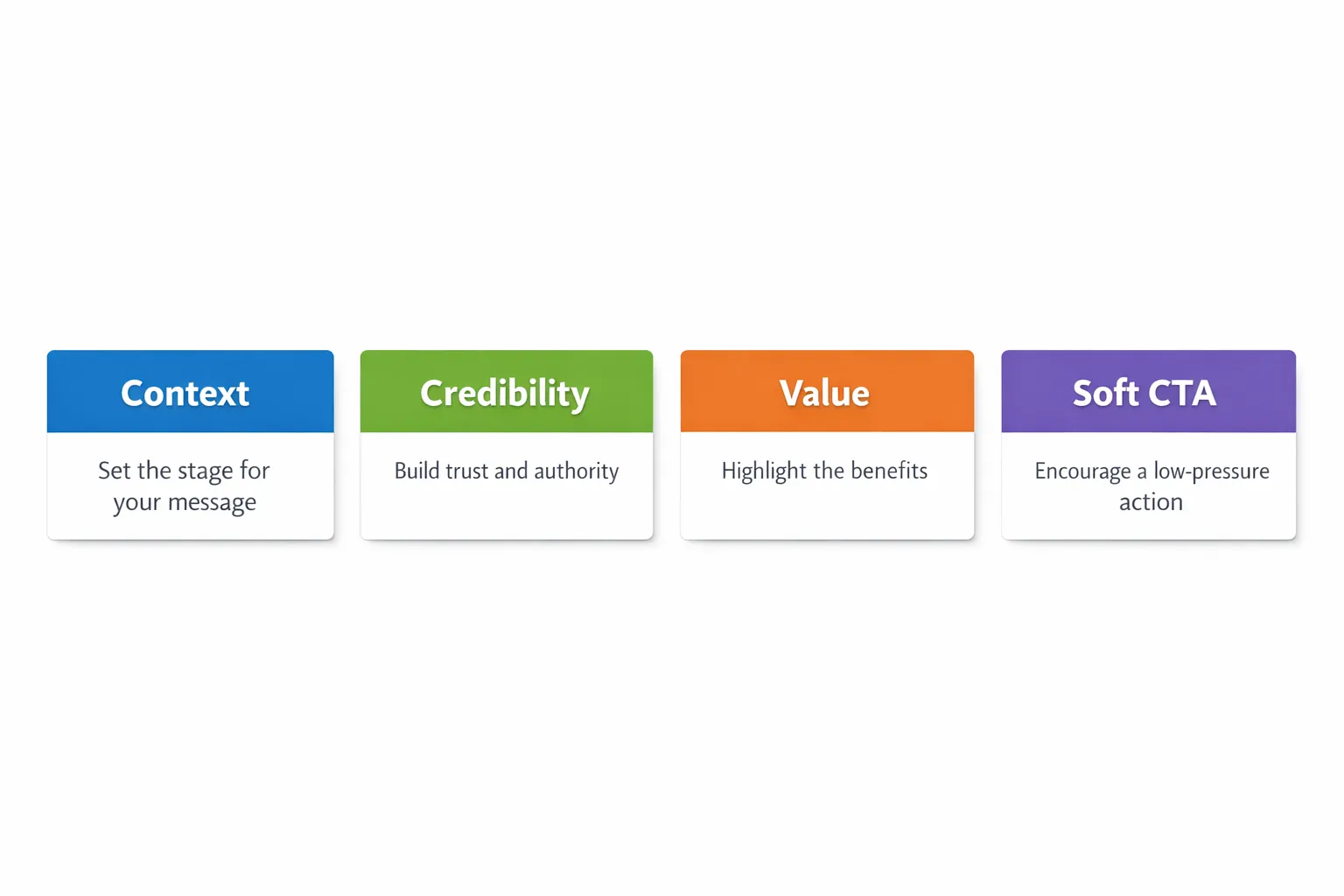
A simple anatomy you can reuse:
- Context, why you are reaching out now
- Credibility, why you are relevant
- Value, the useful thing you can do
- Soft CTA, a micro yes
Connection note templates (use when sending the invite)
These are under 300 characters. Pick one style and personalize the bracketed parts.
Saw your post on [topic]. We help teams turn LinkedIn replies into qualified meetings. Open to a quick idea?Noticed your work at [company]. I have a short playbook for SDRs on LinkedIn that avoids spam and still books meetings. Worth a look?Congrats on the new role at [company]. I have two ways leaders reduce manual prospecting time without losing personalization. Share?First message after acceptance
The goal is to earn a reply, not a full pitch. Lead with the buyer’s context, then a single offer.
Thanks for connecting, [name]. I saw [trigger, for example a hiring post for SDRs]. Happy to share a short outline we use to personalize at scale on LinkedIn without blasting. Want it?Appreciated the connect. We work with teams using [tool in their stack], helping them qualify in-thread on LinkedIn, then book directly. If a 2-slide example helps, I can send it over. Interested?Quick idea for [company]: a 3-message LinkedIn sequence that gets replies without asking for time upfront. If I paste it here, would that be useful?Follow-up nudges that feel helpful
Space these 2 to 4 days apart. Each should add something new.
Circling back with the sequence I mentioned. Message 1 focuses on a single trigger, message 2 adds a proof point, message 3 gives an easy opt-out. Want me to paste the copy here?Dropping a one-liner from a similar team: “We moved qualification into the thread and only asked for time after 3 green flags.” If a short checklist helps, I can share. Interested?No need to reply if timing is off. If you prefer a short read, I can send a two-minute overview of how teams keep LinkedIn safe while scaling personalization. Want it?Breakup that leaves the door open
Closing the loop so I do not clutter your inbox. If LinkedIn-led qualification becomes a priority later, I am happy to share the sequence and metrics. Otherwise I will step back for now.Trigger-based templates that earn fast replies
Use a recent, verifiable event to make your outreach timely.
Funding or product launch
Congrats on the [funding or launch], [name]. When teams hit that stage, leaders often protect seller time by moving early discovery into the LinkedIn thread. I can share the 5 questions we use to qualify politely. Want the list?Hiring SDRs or BDRs
Saw you are hiring SDRs. While new hires ramp, some teams run a light LinkedIn program that warms accounts and books early meetings. A 9-minute overview worth sending?Tech stack signal
Noticed you run [CRM or sequencing tool]. We commonly pair it with a LinkedIn-first workflow that scores replies and only escalates when fit is clear. If a one-pager helps, I can share. Interested?Content interaction or event mention
Your comment on [topic] matched what we see, short messages beat long pitches. I keep a library of sub-80-word templates that still get meetings. Want 3 that map to your use case?Competitor displacement without naming the competitor
If you ever reconsider your LinkedIn approach, I can share how teams kept the same target list and lifted replies by focusing on trigger-first messages. Happy to swap notes?Persona-flavored openers
Tailor the value line to the owning problem.
For a VP Sales
Most VPs tell me they care less about volume and more about meeting quality. I can share a short rubric we use to score replies before asking for time. Want it?For RevOps or Sales Ops
We instrument LinkedIn conversations so replies sync with fit and intent scores in CRM. If a quick checklist for fields and governance helps, I can send it over. Useful?For Marketing or Demand Gen
We are seeing better meeting rates when outreach mirrors your narrative and content. I can show a small playbook that turns recent posts into respectful DM openers. Interested?Short email counterparts
If you pair LinkedIn with email, keep the subject line clean and the body tight. Send from a real person, not a no-reply.
Subject: quick idea for [company]

Hi [name], saw [trigger]. We help teams move light qualification into the first conversation on LinkedIn, then book clean handoffs to AE calendars. If a 2-slide example helps, I can share. Worth sending?
Subject: keep it short?
[Name], if you prefer examples over meetings, I have three sub-80-word messages that earn replies without pushing time. Should I paste them here?Subject: timing
If this is not on your list this quarter, I can circle back later. If it is, I can send a one-pager on how teams run safe, personalized LinkedIn at moderate scale. Helpful?Objection handling snippets that keep the door open
Use these as single replies inside the thread. Do not argue. Offer a path that respects their reality.
- “Send info.”: Great, what format works best, short email, one-pager, or two-slide example?
- “No budget.”: Understood. Many teams start with a small test just to validate reply lift. If sharing the test plan helps, I can send it for later.
- “We already have a tool.”: Makes sense. We often layer on better prompts and guardrails rather than swapping tools. Want the checklist, no commitment needed?
- “Not a priority.”: Thanks for the clarity. Would it be useful if I share the 3 signals our teams watch for that tell them the timing changed?
If your team wants to practice objection handling and live discovery in a safe environment, consider AI roleplay training to sharpen responses before they hit prospects.
Micro-CTAs that lift reply rates
Rotate these to avoid sounding repetitive.
- Want me to paste it here?
- Should I send a one-pager or two slides?
- If not now, when should I circle back?
- Is this even in your lane, or is there someone you prefer I bother instead?
- Open to a quick compare notes chat if the examples land?
A 3-message sequence you can deploy today
Run this on a tight, well-researched list. Personalize the bracketed fields and the trigger.
Message 1, trigger-first

Saw [trigger], [name]. We help teams qualify lightly in the LinkedIn thread so SDRs only book when the fit and intent are clear. Want a 2-slide example?
Message 2, value add
The example shows prompts, guardrails, and metrics. If you prefer text, I can paste a 3-line version here. Which is easier?Message 3, graceful opt-out
If this is not useful, I can step back. If a small test plan helps your team later, I can send that instead. What is best?Template pack for common triggers
Copy, paste, and swap the bracketed fields.
Job change

Congrats on the move to [company]. If you are rethinking the prospecting motion, I can share how teams keep personalization strong while scaling. Share?
New ICP or segment expansion
Saw you are moving into [segment]. We have a lightweight approach for running 3 micro-campaigns to learn fast before you scale. Want the outline?Partner or channel motion
Noticed your partner announcement. A short partner-first opener can unlock intros on LinkedIn. I can send a template if helpful?Event follow-up, still cold
I did not catch you at [event], though I saw your team on the agenda. Happy to share 3 messages that convert event interest into meetings without pushing hard. Interested?Measure and iterate without guesswork
Do not optimize for vanity metrics. Focus on early signals that correlate with meetings.
| Metric | What it tells you | If it is weak, try this |
|---|---|---|
| Connection acceptance | List quality and relevance of your icebreaker | Sharpen ICP, use fresher triggers, tighten the note |
| First reply rate | Message clarity and the strength of your micro-CTA | Remove extra ideas, reduce length, make the ask smaller |
| Positive intent rate | How often replies move toward a meeting | Add credibility line, anchor on a concrete outcome, avoid jargon |
| Qualified conversation rate | Whether your thread earns the right to schedule | Introduce 1 to 2 lightweight questions, do not hard-pitch time |
| Meetings booked | Whether your CTA converts when intent appears | Offer two time windows, include a simple calendar link when invited |
Run simple A or B tests. Change one variable at a time, such as the first line, the CTA, or the trigger. Let each variant run long enough to be fair across days and segments.
- Start with 2 to 3 variants per touch.
- Use small, clean segments by persona or trigger so you can learn why it worked.
- Promote winners, retire losers, and keep a library of proven lines.
If you need a deeper guide to safe testing on LinkedIn, see our playbook on Automated LinkedIn Outreach, Do It Safely and Effectively.
Governance, tone, and safety
Buyers are more sensitive to automation than ever. Treat outreach like a conversation, not a campaign.
- Keep opt-out language easy and honored.
- Avoid attachments on first touch. Offer to paste or send a one-pager.
- Respect compliance and platform policies, including pacing and connection limits.
- Use a clear voice guide so your messages feel consistent across your team.
Our post on LinkedIn Outreach That Converts has more examples and a suggested cadence timeline.
How to operationalize these templates with Kakiyo
The fastest way to learn is to push real conversations, then instrument them.
- Use customizable prompts to codify your voice and guardrails.
- Launch 2 to 3 A or B prompt tests per message step and let the system route traffic evenly.
- Apply intelligent scoring to surface fit and intent so SDRs jump into high-value threads.
- Keep conversation override control, humans can take over at any time.
- Review results in a centralized real-time dashboard and adjust quickly.
Kakiyo manages autonomous LinkedIn conversations, qualifies prospects in-thread, and books meetings so SDRs can focus where they add the most value. If you are aligning outreach with your funnel definitions and handoffs, our guide on the lead qualification process shows how to standardize stages and SLAs around conversation signals.
Final swipe file, 10 lines worth saving
Use these as building blocks across your touches.
- Saw [trigger]. If a 2-slide example helps, I can send.
- I have three sub-80-word messages that earn replies. Want them?
- We moved light qualification into the thread, happy to share the questions.
- Prefer text here or a one-pager by email?
- If not now, when should I circle back?
- Is this even in your lane, or should I reach out to [role]?
- Congrats on [event]. Two ideas that fit that direction, want them?
- Happy to paste the copy here if that is easier.
- No pitch, just a short checklist you can use with or without us. Interested?
- If this is noise, I will step back, just say the word.
Bring these templates to life with tight lists, timely triggers, and respectful pacing. Then let data guide your tweaks. If you want to scale what works, Kakiyo can run the conversations, test prompts, qualify in-thread, and book meetings while your team stays in control.
FAQ
What makes a LinkedIn or cold outreach sequence effective?
An effective outbound sequence matches the buyer's context, uses short messages, and measures reply quality rather than raw volume. Cadence, targeting, and stop rules matter as much as copy.
How many touches should I use before stopping?
Most teams should stop once intent is clearly absent or once the sequence becomes repetitive. The right stop rule protects deliverability, reply quality, and brand perception.
Should I automate all outreach?
No. Automation should remove repetitive work, not replace judgment. The best systems automate targeting, timing, and admin while keeping messaging and qualification grounded in context.
How do I know whether outreach is working?
Track positive reply rate, meeting quality, and downstream conversion instead of open rates alone. If meetings do not progress, the issue is usually targeting or qualification, not activity volume.