
 Ilan Asseo
Sales Development Representative Job Description: 2025 Guide
Use this 2025 Sales Development Representative job description to define responsibilities, KPIs, hiring criteria, and modern outbound expectations.

Hiring a Sales Development Representative in 2025 is not just about scheduling meetings. The modern SDR activates intent, runs buyer-first conversations on LinkedIn, uses AI to qualify in-thread, and hands off clean, timely opportunities your AEs can close. This guide gives you a copy-ready Sales Development Representative job description, clear responsibilities and KPIs, interview questions, and a 30-60-90 plan tailored for today’s AI-enabled, LinkedIn-first prospecting motion.

Industry evidence: Salesforce Research reports that sales reps spend only 28% of their week actually selling, with the rest consumed by deal management, data entry, and other non-selling work.
Source: Salesforce State of Sales
What does a Sales Development Representative do in 2025?
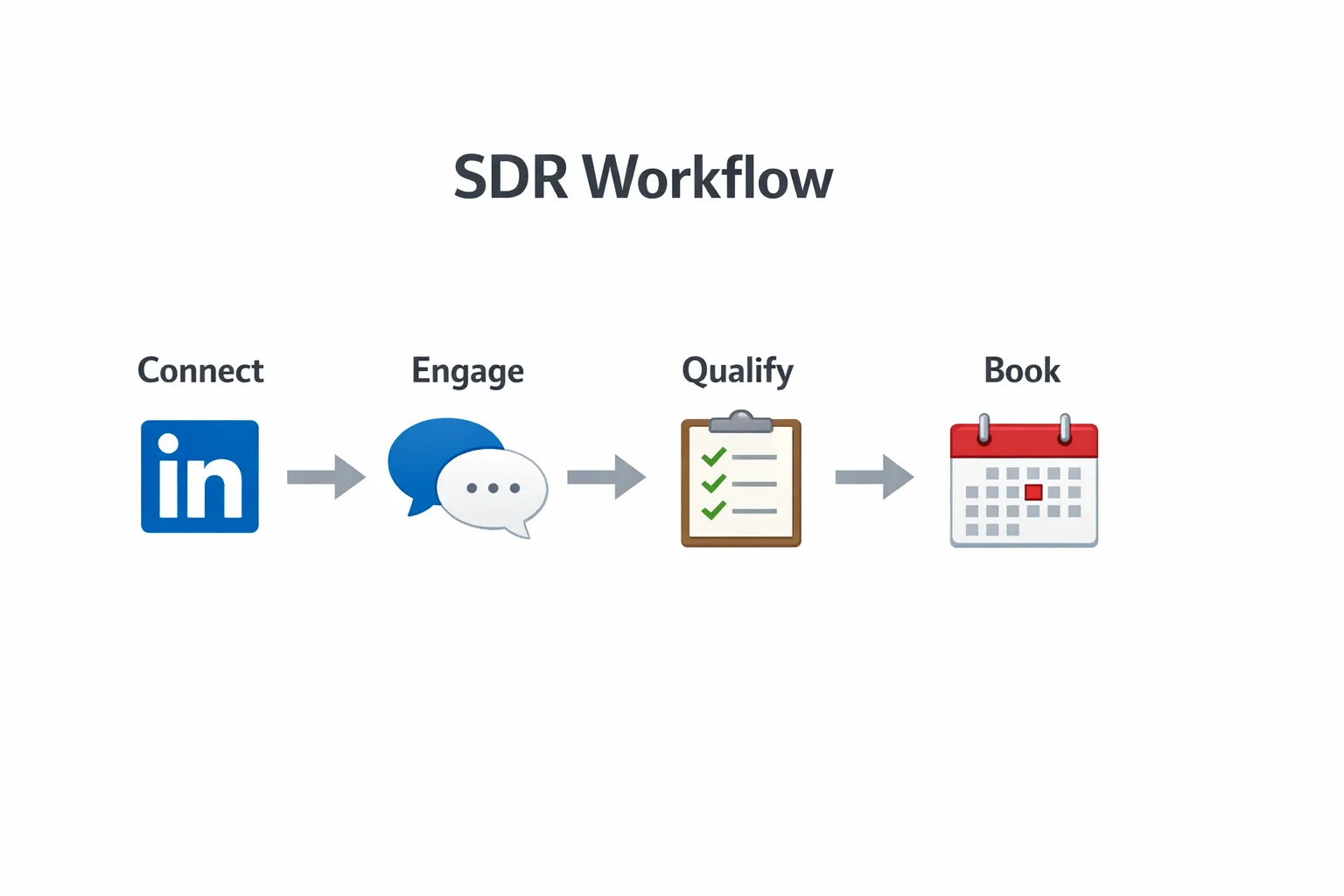
An SDR creates qualified pipeline, not just meetings. In practice, that means identifying and engaging the right buyers, running short contextual conversations, disqualifying quickly when there is not a fit, and packaging next steps cleanly for sales. The channel mix has shifted, with LinkedIn DMs and warm trigger outreach driving more respectful conversations than high-volume cold emails in many markets. AI now handles repetitive research and message drafts, while humans set strategy, quality, and tone.
If you are standing up a LinkedIn-first motion, pair this article with our practical playbooks: LinkedIn Prospecting Playbook: From First Touch to Demo, LinkedIn Outreach Messages That Get Replies, and Lead Qualification Process: Steps, Scoring, and Automation.
Copy-ready Sales Development Representative job description template
Use the template below as your baseline, then tailor outcomes, ICP, and stack to your team. Bracketed text indicates where to customize.
Role title
Sales Development Representative (SDR)
Location
[City, State] or [Remote, US]
About [Company]
[One paragraph on your mission, customers served, and what makes your team different. Include stage, key milestones, funding only if you publicly share it, and the problem you solve.]
The opportunity
As an SDR at [Company], you will create qualified pipeline by running respectful, targeted outreach to our ideal customers, with a strong focus on LinkedIn conversations and short email follow ups. You will partner with Marketing and AEs to identify high-signal prospects, personalize at scale using AI and templates, qualify in-thread, and schedule high-intent meetings.
What you will do
- Own top-of-funnel outreach for a defined ICP, using LinkedIn Sales Navigator and light email to start relevant conversations.
- Personalize messages using context and templates, then qualify in-thread using a clear rubric aligned to our SQL definition.
- Book meetings and coordinate smooth handoffs with AEs, including notes on fit, problem, impact, and timeline.
- Maintain clean CRM data and track micro-conversions, for example acceptance, reply, qualified conversation, and meeting.
- Run small A/B tests on messages and cadences, share learnings, and iterate weekly.
- Monitor trigger events, for example hiring, funding, tech installs, and engage timely with buyer-first messages.
- Use approved AI tools to draft or summarize messages, while maintaining compliance with platform rules and privacy policies.
What you will bring
- Clear, concise writing and a friendly, buyer-first tone.
- Curiosity and research habits that help you find and use context.
- Discipline with process, CRM hygiene, and weekly testing.
- Comfort with AI-assisted workflows, templates, and scorecards, with human judgment to keep quality high.
- 1 to 3 years in an SDR, BDR, or customer-facing role preferred, but we value potential and coachability.
Success looks like
- Consistent weekly progress across acceptance rate, reply rate, qualified conversation rate, and meetings booked.
- Clean handoffs that AEs confirm are on-target.
- Visible contribution to pipeline and learning loops that lift the whole team.
KPIs you will track
- Connection acceptance rate, reply rate, qualified conversation rate, meetings booked, meeting show rate, and SQL rate. Targets vary by segment and season. We set goals collaboratively during onboarding.
Tools you will use
- LinkedIn Sales Navigator, CRM ([Salesforce or HubSpot]), sequencing ([Outreach or Salesloft]), calendar scheduling ([Calendly]), conversation intelligence ([Gong or Chorus]). We also use AI tools to scale personalization and conversational qualification.
Working model
[Hybrid schedule or Remote expectations], with collaboration windows aligned to AE and Marketing partners.
Compensation
Base salary range [insert local range], with variable compensation tied to qualified pipeline and meetings booked. Total compensation varies by location, experience, and performance.
Equal opportunity
[Company] is an equal opportunity employer. We celebrate diversity and are committed to creating an inclusive environment for all employees.
How to apply
Please submit your resume and a short note, 3 to 5 sentences, explaining a time you turned a cold prospect into a positive conversation. Include a sample outreach message you are proud of.
Responsibilities and outcomes, mapped
| Responsibility | What it means in practice | Primary channel | Outcome it drives |
|---|---|---|---|
| Target the right buyers | Build focused lists by ICP, triggers, and account priorities | LinkedIn Sales Navigator | Higher acceptance rate |
| Start respectful conversations | Short, relevant messages that reference credible context and ask a micro question | LinkedIn DMs, light email | Higher reply rate |
| Qualify in-thread | Use a simple rubric on fit, problem, impact, and timing, then confirm next step | LinkedIn DM thread | Qualified conversation rate |
| Book and hand off | Offer two time windows, calendar link optional, summarize thread context in CRM | Calendar, CRM | Meetings booked and show rate |
| Learn and iterate | Run small A/B tests, share wins, adjust templates and prompts weekly | Analytics | Lift across all leading indicators |
For message anatomy and cadence examples, see LinkedIn Outreach That Converts: Proven Templates and Tips.
Inbound vs. outbound SDR variations
If your motion is mixed, define the blend in the job description.
- Inbound SDR: Respond quickly to hand-raises, qualify, and route, with a strict SLA for first response time. Metrics emphasize speed to first touch, qualification rate, and conversion to opportunity.
- Outbound SDR: Run targeted micro-campaigns to trigger-rich accounts, with careful pacing to stay compliant. Metrics emphasize acceptance, reply, qualified conversations, and booked meetings.
Skills and requirements for a 2025-ready SDR
- Buyer-first communication, crisp writing, and respectful questioning.
- Research skills, including reading signals from profiles, posts, hiring, and tech stack.
- Prompt crafting basics to get quality AI outputs and maintain tone.
- Light data skills, for example list building, filters, and reporting.
- Process habits, for example daily time blocking, notes, hygiene, and SLAs.
- Integrity and compliance mindset with LinkedIn policies and privacy standards. For safe automation on LinkedIn, review Automated LinkedIn Outreach: Do It Safely and Effectively.
30-60-90 day onboarding plan
- First 30 days, learn the ICP, product, and message voice, set up tools, shadow top SDRs, write 20 practice messages, and review them with your manager.
- Days 31 to 60, own a small ICP slice, run two message tests at a time, book early meetings, and document what works in a shared playbook.
- Days 61 to 90, expand account coverage, focus on qualified conversation rate and show rate, and contribute two improvements to templates or process.
Metrics and reasonable directional targets
Every segment is different, and targets vary by market, brand, and ACV. Treat the bands below as directional examples to calibrate during onboarding.
| Metric | Definition | Why it matters | Directional band |
|---|---|---|---|
| Connection acceptance rate | Accepted connections divided by requests | List quality and message relevance | 30 to 60 percent |
| Reply rate | Unique positive or neutral replies divided by messages | Conversation quality | 10 to 25 percent |
| Qualified conversation rate | Threads meeting fit and intent criteria | Signal that meetings are worthwhile | 25 to 50 percent of replies |
| Meetings booked | Booked calls with buyer consensus | Pipeline creation | 20 to 40 per month, segment dependent |
| Show rate | Held meetings divided by booked | Handoff quality and buyer intent | 70 to 90 percent |
| SQL rate | Booked meetings that meet sales qualification | Pipeline precision | 40 to 70 percent of meetings |
If you are formalizing SQL criteria, see What Is a Sales Qualified Lead? Examples and Benchmarks.
Interview questions that map to the job
- Show me a 60 to 80 word LinkedIn DM to a VP of [function] referencing [credible trigger]. What is your micro question and why?
- Walk me through a time you disqualified quickly. What signals told you it was not a fit, and how did you exit respectfully?
- How do you decide what to A/B test week to week? What is a recent learning you turned into a template update?
- Give an example of using AI to speed up outreach without losing voice. What prompts or guardrails did you use?
- A prospect replies with a polite no. Draft your two-sentence response to keep the door open.
Score candidates on clarity, relevance, curiosity, and judgment. Ask for writing samples when possible.
The tool stack in a lean SDR team
Start with a minimal, revenue-focused stack. For a 2025 view by job to be done and evaluation tips, see Best AI Sales Tools for SDR Teams in 2025. At minimum you will need CRM, LinkedIn Sales Navigator, a sequencing tool, scheduling, and analytics. If you run LinkedIn-first, add a governed AI conversation layer to manage scale and quality.
How AI changes the SDR job description
AI does not replace the SDR, it augments output when you design the workflow well. Automate the repetitive, keep humans in control of strategy, tone, and exceptions.
- What to automate: research summaries, first-draft messages, in-thread qualification prompts, scorecards, and meeting logistics.
- What humans own: ICP and messaging strategy, voice, prioritization, objection handling nuance, and governance.
If you want autonomous, personalized LinkedIn conversations with human override and analytics, see how Kakiyo supports teams with autonomous conversations, AI-driven lead qualification, customizable prompt creation, A/B prompt testing, industry-specific templates, an intelligent scoring system, simultaneous conversation management, conversation override control, a centralized real-time dashboard, and advanced analytics and reporting. For real-world motions and KPIs, review Conversational AI for Sales: Real-World Use Cases.
Salary and compensation guidance
Publish a transparent range based on your market, seniority band, and segment, and split variable compensation between meetings and qualified pipeline to reward quality. Calibrate with current data from reputable sources in your region and update annually. Include benefits and remote or home-office stipends if applicable.
Common pitfalls to avoid in your job description
- Vague outcomes, for example asking for hustle without defining qualified conversation or SQL. Replace with measurable goals.
- Channel mismatch, for example requiring high-volume cold email when your buyers live on LinkedIn. Align to where buyers actually engage.
- Over-indexing on years of experience. Hire for writing, curiosity, and process, then coach.
- Ignoring compliance. State expectations for respectful outreach and platform policy adherence.
FAQ
What is the difference between an SDR and a BDR? In most teams, the roles overlap. SDR often implies handling inbound and outbound for a defined ICP, while BDR is sometimes used for outbound only. Clarify in your description whether the role is inbound, outbound, or mixed.
How many meetings should an SDR book per month? It depends on segment and ACV. Use a collaborative target that considers your acceptance, reply, and qualified conversation rates, then back into a realistic meetings goal.
Do SDRs need prior sales experience? Not necessarily. Strong writing, curiosity, and process discipline predict success. Many teams hire early-career candidates and coach the craft.
How should we measure quality, not just volume? Track qualified conversation rate, SQL rate, and show rate alongside meetings. Ask AEs to confirm fit and intent on handoffs.
What does a good onboarding plan include? Clear ICP and message training, tool setup, a simple qualification rubric, writing practice with feedback, and two to three controlled A/B tests by week four.
Which channels should SDRs prioritize in 2025? Many teams see higher-quality conversations on LinkedIn, with email and phone supporting. Match the mix to where your buyers respond best.
How does AI fit into the SDR role? Use AI to scale personalization, qualify consistently, and analyze performance, while humans own strategy, tone, and exceptions. Keep governance and override controls in place.
Ready to modernize your SDR motion?
If your team sells where your buyers live on LinkedIn, you can scale respectful, 1 to 1 conversations without sacrificing quality. Kakiyo’s AI manages personalized LinkedIn conversations from first touch to qualification to meeting booking, so SDRs spend time on high-value opportunities. Explore how it works or request a walkthrough at Kakiyo.com, and deepen your playbook with our guides on AI SDR: Automate Conversations, Qualify Faster, Book More and AI for Sales Prospecting: Tactics That Book Meetings.