
 Ilan Asseo
LinkedIn Outreach Messages That Get Replies
Frameworks, templates, and a 14-day test plan to write short, relevant LinkedIn messages that earn replies and convert conversations into meetings.

Getting replies on LinkedIn is about earning a tiny next step, not forcing a meeting. Buyers reply when a message is relevant, low effort to answer, and clearly helpful. This guide gives you clear frameworks, copy-and-paste outreach messages for common scenarios, and a simple testing plan to raise reply rates without burning your market.
LinkedIn has shared for years that concise, personalized InMail performs better than long, generic notes. Keep messages short, make the benefit obvious, and end with one easy question. For additional context on why this works, see guidance from LinkedIn Sales Solutions and research on how questions drive engagement from Harvard Business Review.
- LinkedIn Sales Solutions messaging guidance: https://www.linkedin.com/business/sales/blog
- The Surprising Power of Questions, HBR: https://hbr.org/2018/05/the-surprising-power-of-questions
- Why brevity and scannability improve comprehension, Nielsen Norman Group: https://www.nngroup.com/articles/scannability/
Industry evidence: “As customers increasingly learn and buy digitally, sales reps become just one of many possible sales channels.” — Cristina Gomez, Managing Vice President, Gartner.
Source: Gartner
What makes a LinkedIn outreach message get replies
- Relevance beats cleverness. Tie the message to a current trigger, a clear role responsibility, or a peer result the buyer recognizes.
- One bite-sized ask. End with a question that can be answered in a sentence. Save calendar asks for after interest is confirmed.
- Helpful specificity. Offer a small asset in-thread, like a 60 second summary, a one-slide teardown, or a snippet they can copy.
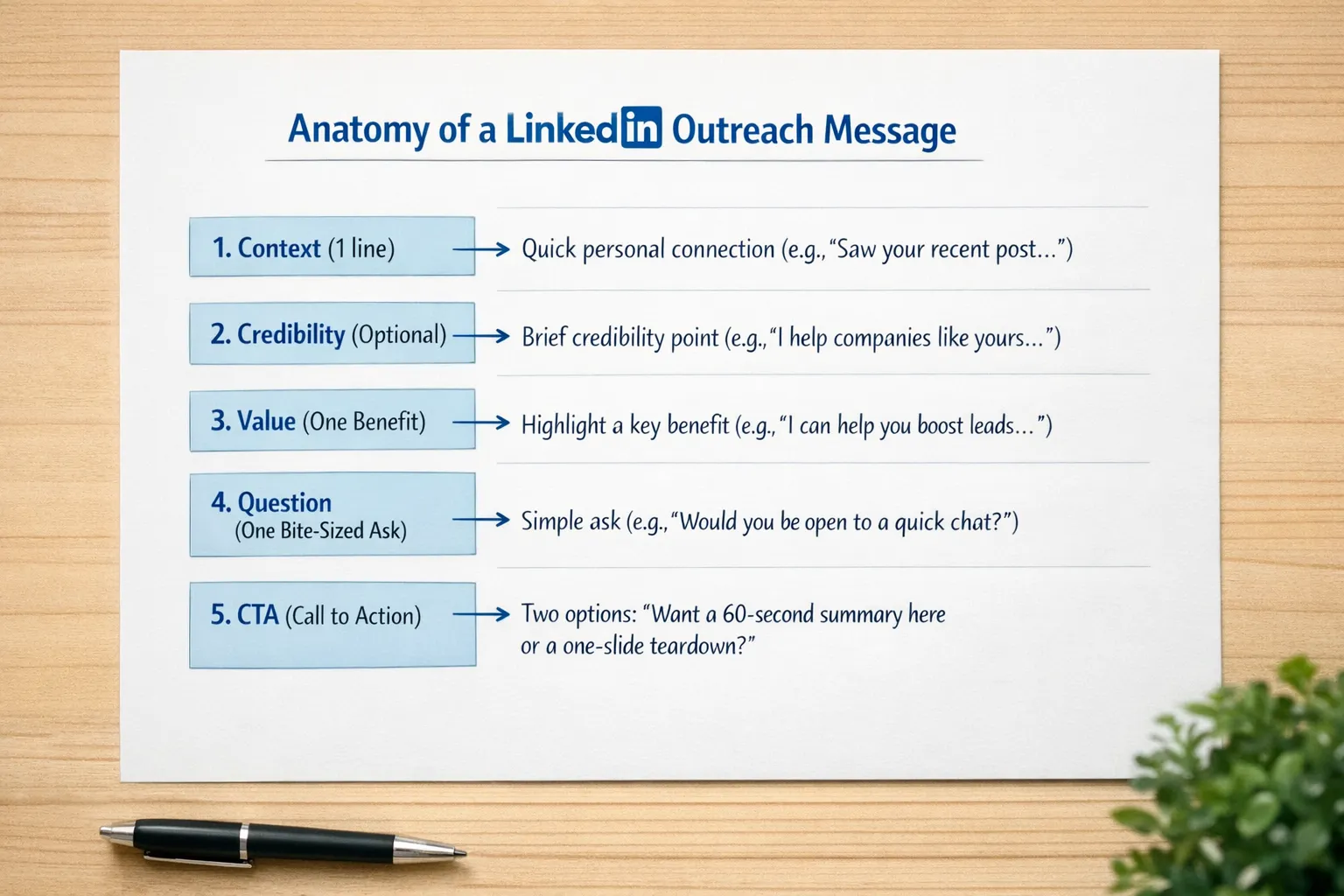
The 5-part anatomy of a reply-worthy LinkedIn message
- Context, one line that proves you are relevant now
- Credibility, optional peer or quick proof
- Value, the one outcome the buyer cares about
- Question, one specific, easy-to-answer prompt
- CTA, two options so the buyer can say yes without a meeting
Message types, goals, and CTA examples
| Scenario | Goal | Suggested length | Best opener style | Example CTA |
|---|---|---|---|---|
| Connection note | Earn acceptance and curiosity | 25 to 120 characters | Trigger or peer anchor | Open to a 1 line idea if relevant? |
| First message after acceptance | Start a real exchange | 1 to 3 sentences | Trigger plus value wedge | Want a 60 second summary here, or a one-slide teardown? |
| Nudge follow-up | Restart stalled thread | 1 sentence | Micro-yes | Still relevant to share the 60 second summary, or should I close the loop? |
| Referral ask | Find the right owner | 1 to 2 sentences | Respectful ask | If not you, who owns this at Company? |
| InMail | Spark reply without a connection | 2 to 4 sentences | Problem-first | Want me to send the 60 second version here? |
21 copy-and-paste LinkedIn outreach messages that get replies
Personalize the bracketed fields. Keep the tone human and light. Do not stack multiple asks.
Connection notes
Quick one on [topic] at [Company]. We helped [peer] with [outcome]. Open to a 1 line idea?
Saw you are driving [initiative]. I have a template peers use for [outcome]. Want it?
Congrats on the new role, [FirstName]. I have a 60 second summary of wins teams land in the first 90 days. Want me to send it?
First messages after acceptance
Thanks for connecting, [FirstName]. I noticed [trigger, for example new product launch]. Teams like [peer] used a simple workflow to cut [pain] in week one. Want a 60 second summary here, or a one-slide teardown?
Appreciate the connect. You mentioned [topic] in your recent post. We see [pattern] across [industry] and a small change usually lifts [metric]. Want the 3 bullet version, or a quick example from [peer]?
Keeping it brief. We help [role] reduce [pain] without changing tools. Want me to send a 4 step checklist, or a 1 slide before and after?
Trigger based messages
Noticed [Company] just raised [round]. Many teams use the hiring window to fix [pain] before scale. Want a one slide on what usually moves the needle first?
Saw you are hiring for [role]. I have a proven ramp checklist that cuts time to first meeting. Want the 60 second version?
Congrats on [tool adoption or migration]. We have a plug and play way to get [outcome] from it faster. Want me to share a quick snippet you can copy?
Mutual interest or content engagement
Your post on [topic] resonated. One nuance we see, [insight]. I can share a compact template teams apply in under 5 minutes. Interested?
Enjoyed your comment in [group or thread]. We tested [idea] with [peer], it moved [metric]. Want the setup steps, or should I send the screenshot summary?
Referral to the right person
[FirstName], I may be off. Who owns [problem area] at [Company] today, you or someone on your team? Happy to send a 60 second summary to the right person.
If not you, who is the best owner for [initiative] at [Company]? I can share a one slide option that peers use.
Follow ups that do not annoy
Circling back, should I send the 60 second summary, or close the loop for now?
Flagging this in case it slipped, the one-slide teardown is ready if useful. Want it, or not a priority right now?
If timing is off, no worries. Do you want me to park this until [date or event], or share the quick version now?
The respectful breakup
I will close the loop to keep your inbox clean. Before I do, want the 60 second summary for later, or should I archive this thread?
Two InMail variants
Subject, Quick idea for [Company] on [topic]
Body, We help [role] at [peer] reduce [pain] without process changes. I can send a 60 second summary here so you can scan it in line. Want me to send it?
Subject, [FirstName], 1 idea on [initiative]
Body, Not a pitch. We noticed [trigger] and a simple workflow lifted [metric] for [peer]. If helpful, I can share a one slide teardown here. Open to it?
Personalization signals that actually lift replies
Avoid generic flattery. Use one strong signal, then move to value and an easy question.
- Role responsibility, tie to what this job owns. Example, As RevOps, you likely own speed to lead on LinkedIn inbound.
- Public trigger, funding, hiring, product launch, new role, event speaking.
- Peer proof, 1 named peer or anonymized proof if sensitive.
- Stack or process, tool migrations, new CRM, new sales engagement platform.
- Content cue, post, comment, podcast quote, or webinar attendance.
- Metric tension, hint at the measurable pain you solve, for example reply rate, meetings per 100 connections, speed to first qualified conversation.
Turn one signal into one line, then add your value wedge and question.
Write with the QVC micro framework
- Question, start with a tiny, specific question that proves relevance
- Value, one sentence on the outcome you enable
- Choice, two ways to engage without a meeting
Example, Noticed hiring for two SDRs. We help new teams get to first meetings faster without extra tools. Want a 60 second play, or a one slide rundown?
Metrics to track and improve
| Metric | Definition | Why it matters |
|---|---|---|
| Connection acceptance rate | Accepted connections divided by sent requests | Early relevance and profile fit |
| Reply rate | Unique replies divided by first messages sent | Core signal the message earned engagement |
| Positive intent rate | Replies that show interest divided by replies | Quality of your value wedge |
| Qualified conversation rate | Threads that meet your qualification criteria | Focus on real opportunities |
| Meetings booked | Confirmed meetings from LinkedIn threads | Bottom line outcome |
For deeper playbooks on the funnel, see our LinkedIn outreach templates and our LinkedIn prospecting playbook from first touch to demo.
- LinkedIn outreach templates: https://kakiyo.com/blog/linkedin-outreach-that-converts-proven-templates-and-tips
- Prospecting playbook: https://kakiyo.com/blog/linkedin-prospecting-playbook-from-first-touch-to-demo
A simple 14 day test plan to raise reply rates
- Define a tight list, one ICP, one use case, one trigger.
- Draft two message variants that differ in opener style, trigger first versus peer first.
- Keep the offer constant, for example 60 second summary or one slide teardown.
- Split send evenly across variants for 5 business days.
- Follow up once at day 3 with a one sentence nudge.
- Measure replies and positive intent, not meetings yet.
- Pick the winner, write two new variants, repeat in week two.
Hold volume steady and test one change at a time. This keeps learnings clean and protects your account health. For a deeper view on safe automation and guardrails, see Automated LinkedIn Outreach, Do It Safely and Effectively.
- Safe automation guide: https://kakiyo.com/blog/automated-linkedin-outreach-do-it-safely-and-effectively
Common mistakes that kill replies
- Asking for time in the first message. Earn the conversation first, then propose a call.
- Writing walls of text. Use one to three sentences, one question.
- Using buzzwords or claims without proof. Name one peer or be specific about the workflow.
- Sending generic sequences to mixed personas. Narrow your audience and your message.
- Ignoring opt outs. If someone says not now, respect it and log it.
Turn replies into meetings without being pushy
Once the buyer engages, shift to a short qualification path and give a simple next step.
- Confirm fit with one or two thread safe questions, for example Which part of [process] is the heaviest lift today, routing, personalization, or scheduling?
- Offer a micro outcome for a call, for example 10 minutes to benchmark your reply rates against peers and share the 4 step workflow.
- Present two times or a self serve link after they show interest. Keep the tone helpful and flexible.
For more on moving from reply to booked demo with data, see AI for Sales Prospecting, Tactics That Book Meetings.
How Kakiyo helps you get more replies, then qualify and book
Kakiyo manages personalized LinkedIn conversations end to end so SDRs focus on the highest value opportunities.
- Autonomous LinkedIn conversations that stay on brand and on topic
- AI driven lead qualification inside the thread
- Customizable prompts and industry specific templates
- A/B prompt testing to learn what earns replies faster
- Intelligent scoring so the right threads escalate at the right time
- Conversation override control, humans can step in any time
- Centralized real time dashboard with analytics and reporting
Run safe, buyer first programs that scale. Start with a tight ICP and a single use case, then let Kakiyo test openers, value wedges, and CTAs while you keep control of tone and guardrails. When replies come in, Kakiyo qualifies in thread and books meetings when there is real interest.
Explore how it works and see real conversations at Kakiyo.
Final word
Great LinkedIn outreach earns replies by being timely, useful, and easy to answer. Use the frameworks and templates above, keep each message short, and test one change at a time. When you are ready to scale without sacrificing relevance or safety, Kakiyo can run the conversations, qualify in thread, and book the meetings while you focus on strategy and high impact conversations.
FAQ
What makes a LinkedIn or cold outreach sequence effective?
An effective outbound sequence matches the buyer's context, uses short messages, and measures reply quality rather than raw volume. Cadence, targeting, and stop rules matter as much as copy.
How many touches should I use before stopping?
Most teams should stop once intent is clearly absent or once the sequence becomes repetitive. The right stop rule protects deliverability, reply quality, and brand perception.
Should I automate all outreach?
No. Automation should remove repetitive work, not replace judgment. The best systems automate targeting, timing, and admin while keeping messaging and qualification grounded in context.
How do I know whether outreach is working?
Track positive reply rate, meeting quality, and downstream conversion instead of open rates alone. If meetings do not progress, the issue is usually targeting or qualification, not activity volume.