
 Ilan Asseo
AI Sales: Use Cases That Actually Work
Practical AI sales use cases across outreach, qualification, booking, and CRM with guardrails, KPIs, and implementation guidance.

AI sales has a credibility problem. Most teams have tried something that sounded impressive (auto-generated emails, generic scripts, AI “autopilot”), only to discover it did not move pipeline, or worse, it created brand risk and junk meetings.
The good news is that AI sales use cases do work, but only when they are applied to specific, measurable moments in the revenue process, with clear guardrails and a tight feedback loop.
Below are the AI sales use cases we consistently see produce real outcomes for SDR teams, RevOps, and sales leaders in 2026, plus how to implement them without turning your outbound into noise.
Industry evidence: “Our research suggests that a fifth of current sales-team functions could be automated.” — McKinsey & Company.
Source: McKinsey
What makes an AI sales use case “actually work”
Working use cases share three traits:
- They optimize an outcome, not an activity. “More emails sent” is not a win. “More qualified conversations per rep-week” is.
- They capture evidence. The best systems save the why (the message thread, the intent signal, the scoring reason), not just the what.
- They’re operationally safe. Human override, pacing controls, and clear rules for when to escalate to a rep.
This matches what broader research keeps showing: value comes from applying AI to well-defined workflows and decision points, not from replacing the entire job. For example, McKinsey’s AI research repeatedly highlights that impact is strongest when organizations redesign workflows around AI rather than deploying tools in isolation (see McKinsey AI insights).
A practical map: use cases by funnel moment
Use this table to pick AI sales projects that are easy to measure and hard to fake.
| Funnel moment | AI sales use case | Primary KPI to measure | What “good” looks like | Main risk to guardrail |
|---|---|---|---|---|
| First touch | Personalized outreach generation and delivery | Reply rate, positive reply rate | Higher reply rate without more follow-ups | Generic messaging, policy violations |
| Early conversation | In-thread qualification | Qualified conversation rate | More threads that reach clear next steps | Asking too much too soon |
| Handoff to meeting | Scheduling and confirmation | Meetings booked and held | Fewer no-shows, cleaner handoffs | Poor context transfer |
| Post-meeting | Follow-up and nurture | Meeting-to-opportunity conversion | Faster next step acceptance | Hallucinated recap content |
| Ongoing | Pipeline hygiene and signal capture | Forecast accuracy inputs, stage aging | Cleaner CRM and faster deal movement | Overconfidence, bad data |
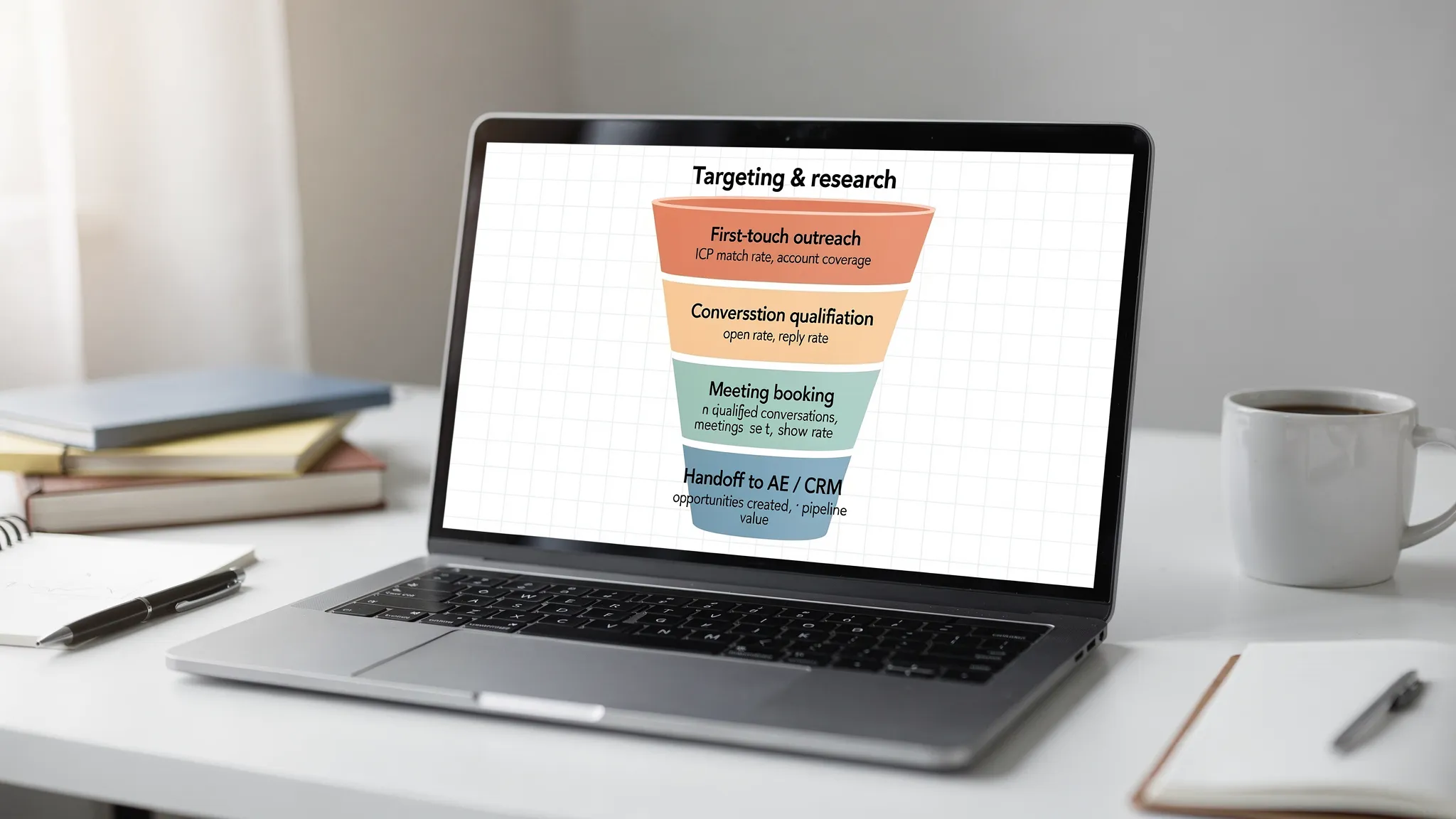
Use case 1: Autonomous LinkedIn conversations that qualify and book meetings
If you sell B2B, LinkedIn is not just a channel, it’s a living thread where buyers ask questions, raise objections, and reveal intent. The AI use case that works here is not “send 10,000 DMs.” It’s run high-quality, personalized conversations at scale, then qualify and book only when there’s evidence.
What makes this work:
- Personalization anchored to real context (role, company signal, trigger)
- A conversational flow that earns micro-commitments (reply, answer a question, confirm fit)
- Qualification inside the thread (Fit, Intent, Readiness signals)
- A clean escalation path when a prospect asks for something complex
This is exactly where Kakiyo fits: it autonomously manages personalized LinkedIn conversations from first touch to qualification to meeting booking, with controls like prompt customization, A/B prompt testing, an intelligent scoring system, and conversation override.
If you want the tactical messaging side, Kakiyo already has strong guides on that, for example LinkedIn outreach messages that get replies and the LinkedIn prospecting playbook. This article is about choosing the use case and measuring whether it truly works.
Use case 2: Speed-to-lead for inbound and warm signals (without burning SDR time)
Inbound leads and warm signals decay fast. AI works well when it’s used to respond immediately, ask 1 to 2 smart questions, and route correctly.
This use case tends to produce lift because it removes the two biggest killers of inbound conversion:
- Slow response times
- Inconsistent qualification
What to automate:
- First response (fast, helpful, specific)
- Two-question qualification (confirm fit, capture intent)
- Meeting booking only when thresholds are met
What not to automate fully:
- Anything that looks like a pricing or legal commitment
- Complex technical discovery (route to a human)
If your inbound motion is messy, it helps to first align definitions, then automate. Kakiyo’s lead-stage content around quality gates is a good reference point, for example Lead qualification: a simple, repeatable system and MQLs: definition, scoring, and handoff.
Use case 3: AI-driven qualification that produces auditable “why”
A common AI failure mode is scoring that feels magical. Reps ignore it because they cannot see why it decided what it decided.
The use case that works is assistive qualification that:
- Captures explicit evidence (what the buyer said)
- Summarizes it into a consistent structure (Fit, Intent, Timing, constraints)
- Makes the score explainable
In practice, this can look like:
- Thread summaries that highlight buyer intent and open questions
- A lightweight rubric applied consistently (for example Fit/Intent/Evidence)
- Recommended next question based on what is missing
To build this well, start by defining what “qualified” means in your motion and what proof you expect to see. Kakiyo goes deep on this concept in Qualified leads: scoring that sales trusts.
Use case 4: Prospect research that produces better first lines (and better targeting)
AI can dramatically reduce time spent on account research, but only if you constrain it.
The use case that works:
- Pull a small set of allowed sources (website, LinkedIn profile, recent posts, job openings, press)
- Extract 2 to 3 usable insights (trigger, plausible priority, relevant proof point)
- Generate multiple message angles for testing
What to measure:
- Connection acceptance rate
- Reply rate
- Downstream qualified conversation rate (this is the real test)
If research increases replies but decreases qualification, you created curiosity, not demand.
Use case 5: ABM multi-threading that does not collapse into spam
Multi-threading is one of the highest ROI behaviors in B2B sales, and one of the hardest to do manually. AI helps because it can manage many parallel conversations while preserving context.
The version that works:
- A single account narrative (why now, why you)
- Role-specific angles for each persona
- Pacing rules so you do not hit the same account aggressively
- A handoff moment when two stakeholders show interest (that is when humans win deals)
If you run an ABM motion on LinkedIn, Kakiyo’s conversation management, scoring, and real-time dashboard are designed for this kind of controlled scaling.
Use case 6: Objection handling support that improves consistency (not robotic replies)
AI is useful for objection handling when it acts like a coach and a library, not a mouthpiece.
What works:
- Suggesting 2 to 3 response options aligned to your positioning
- Reminding the rep of the goal of the moment (micro-yes, not full pitch)
- Flagging compliance and brand-risk patterns (over-claims, aggressive language)
What often fails:
- Fully automated “comeback” replies with no awareness of the relationship
- Over-long messages that read like marketing copy
In LinkedIn threads especially, brevity and relevance win. A great objection response is often one sentence plus one question.
Use case 7: Meeting booking that protects held-rate and deal quality
Booking meetings is easy. Booking the right meetings, with the right context, that actually happen, is the job.
AI works here when it:
- Proposes the meeting only after evidence thresholds are met
- Confirms logistics and stakeholders
- Produces a handoff packet (what they said, why they might buy, what they asked)
The KPI is not “meetings booked.” Track:
- Meetings held rate
- AE acceptance rate
- Meeting-to-opportunity conversion
Kakiyo’s focus on qualification plus meeting booking on LinkedIn aligns to this outcome-based approach, rather than optimizing for calendar volume.
Use case 8: CRM hygiene and signal capture (quietly one of the biggest wins)
Most teams underestimate how much pipeline they lose to bad CRM data and missing context. AI can help by:
- Turning unstructured conversations into structured fields
- Detecting missing required data for a stage
- Summarizing latest customer signal in plain English
Where teams get this right, managers spend less time arguing about the forecast and more time fixing real deals. This theme also ties into the idea that conversation signals can be leading indicators, which Kakiyo discusses across several posts on pipeline and measurement, such as SDR sales: from outreach to booked meetings.
Use case 9: Post-meeting follow-up and nurture that maintains momentum
AI-generated follow-ups can help, but only if grounded in real meeting notes and clear next steps.
The working pattern:
- Summarize what was agreed (problems, constraints, decision process)
- Confirm next step with a date and owner
- Personalize nurture based on the explicit buying job (not generic “thought leadership”)
One operational rule that prevents issues: if the system cannot cite the source (call notes, thread text), it should not claim it.
The 30-day implementation plan (pilot one use case, prove lift, then scale)
Most AI sales rollouts fail because teams try to adopt five tools and ten workflows at once. The fastest path to value is a narrow pilot with baseline metrics.
| Week | What you implement | What you measure | Go / no-go criterion |
|---|---|---|---|
| 1 | Define the use case, the stage gate, and the evidence required | Baseline funnel metrics (current state) | Everyone agrees on definitions |
| 2 | Launch a controlled pilot (limited segment, clear prompts, clear escalation rules) | Reply rate plus qualified conversation rate | No brand-safety incidents |
| 3 | Run structured experimentation (A/B prompts, persona angles, qualification questions) | Lift vs baseline, plus quality metrics (AE acceptance, held rate) | Lift is real, not just volume |
| 4 | Harden operations (dashboards, overrides, scoring calibration, training) | Consistency, adoption, cycle time | Ready to expand segment |
If your pilot is specifically LinkedIn-first outbound, Kakiyo is built around the operational pieces that usually break at scale: simultaneous conversation management, A/B prompt testing, scoring, analytics, and human override controls.
Choosing your first AI sales use case (a simple rule)
Pick the use case where you already have intent signals but cannot keep up.
- Too many LinkedIn threads for SDR capacity: start with autonomous conversation management and qualification.
- Too many inbound leads going cold: start with speed-to-lead triage.
- Too many meetings that do not convert: start with evidence-based qualification and better handoffs.
Once one use case works, scaling is straightforward because you have the only thing that matters in AI sales: proof, measured against a baseline.
If you want to see what autonomous, personalized LinkedIn conversations look like in practice, explore Kakiyo and compare it to legacy sequencing approaches in Sales AI tools vs legacy sequencers.
FAQ
Where does AI actually help in sales?
AI helps most when it reduces repetitive work, surfaces better signals, and improves execution speed. It is strongest in research, qualification support, follow-up, and workflow automation.
What are the limits of AI in sales?
AI still depends on clean inputs, good process design, and human oversight. It can accelerate bad workflows just as easily as good ones.
How should teams evaluate AI sales tools?
Evaluate tools by workflow fit, data quality, implementation friction, and measurable business outcomes. A feature-rich tool is not automatically the right tool for your motion.
Does AI replace SDRs or sales reps?
Usually no. In most teams, AI reshapes the role by taking over repetitive execution while humans stay responsible for judgment, positioning, and relationship depth.