
 Ilan Asseo
AI and Sales: Where Humans Stay Essential
Most sales teams didn't adopt AI to reduce relationships—they adopted it to eliminate repetitive tasks, speed follow-up, and ensure consistent execution.

Most sales teams did not adopt AI because they wanted fewer relationships. They adopted it because they wanted fewer repetitive tasks, faster follow-up, and more consistent execution.
That distinction matters, because the best outcomes in AI and sales come from a clear division of labor:
- AI handles volume, speed, and consistency.
- Humans handle judgment, trust, and accountability.
In 2026, buyers are more informed, more skeptical, and more protective of their time. That makes “human” work more valuable, not less. The teams that win are the ones that deliberately protect human attention for the moments where it changes the outcome.
Industry evidence: “Our research suggests that a fifth of current sales-team functions could be automated.” — McKinsey & Company.
Source: McKinsey
What AI is genuinely good at in sales (and why it keeps getting adopted)
AI works best when the task has three properties: it repeats, it produces measurable signals, and it benefits from consistency.
In practical sales terms, AI tends to shine in areas like:
- Speed-to-lead and speed-to-reply: responding quickly to messages, routing, and follow-up.
- Personalization at scale: turning profile, company, and trigger signals into relevant openers.
- Multi-threaded conversation management: tracking dozens (or hundreds) of threads without dropping the ball.
- Structured qualification capture: consistently asking and recording the same core questions.
- Experimentation: A/B testing prompts and messaging variants without reps “freestyling” the test.
If you want a macro lens on why this is happening across industries, McKinsey’s analysis on the economic potential of generative AI explains the productivity upside, especially in knowledge work that includes outreach, research, summarization, and drafting.
But “good at” is not the same as “safe to fully delegate.” Which brings us to the essential human layer.
Where humans stay essential (the work AI cannot “own”)
Even strong models cannot carry responsibility. They can generate, predict, and optimize, but they cannot be accountable for:
- Brand risk
- Customer trust
- Legal and ethical boundaries
- Business trade-offs (for example, margin vs velocity)
- The nuance of complex deals
Here are the sales moments where human contribution remains structurally important.
1) Defining strategy: ICP, positioning, and what “qualified” means
AI can help you analyze patterns, but it cannot choose your strategy.
Humans must decide:
- Which segments you pursue and which you ignore
- What pains you lead with (and what you do not claim)
- What evidence counts as “real intent”
- What you will trade off to win (speed, quality, price, control)
If your ICP is fuzzy, AI will scale the fuzziness. If your qualification definition is inconsistent, AI will automate inconsistency faster.
2) Relationship and trust building in high-stakes moments
Buyers do not just evaluate products, they evaluate risk. Trust is built through:
- Contextual business judgment
- Empathy and listening
- Credible perspective (not just answers)
- Handling friction respectfully
AI can support these moments (by summarizing context, suggesting next questions, or drafting follow-ups), but humans close the trust gap.
3) Discovery that changes the deal
In real discovery, the best question is often not the “next step” question. It is the question that reframes the buyer’s mental model.
Examples of human-only discovery moves:
- Challenging a false assumption without triggering defensiveness
- Reading organizational dynamics (politics, incentives, fear)
- Adjusting depth based on tone, urgency, and credibility
AI can ask a checklist of questions. Humans decide which question matters now.
4) Negotiation, objection handling, and commercial trade-offs
Negotiation is not only language. It is leverage, timing, and risk.
Humans are essential for:
- Concession strategy (what you can give, when, and why)
- Multi-party alignment inside the buyer org
- Interpreting what is really behind “send pricing” or “circle back next quarter”
An AI can propose a response, but a human needs to own the economic outcome.
5) Governance: what your company will and will not do
Sales teams are now running a brand and compliance system, whether they admit it or not.
Humans must define guardrails such as:
- What data is allowed in prompts
- Which claims require proof
- When a conversation must escalate
- How opt-outs are handled
This is not “red tape.” It is how you protect reputation while scaling.
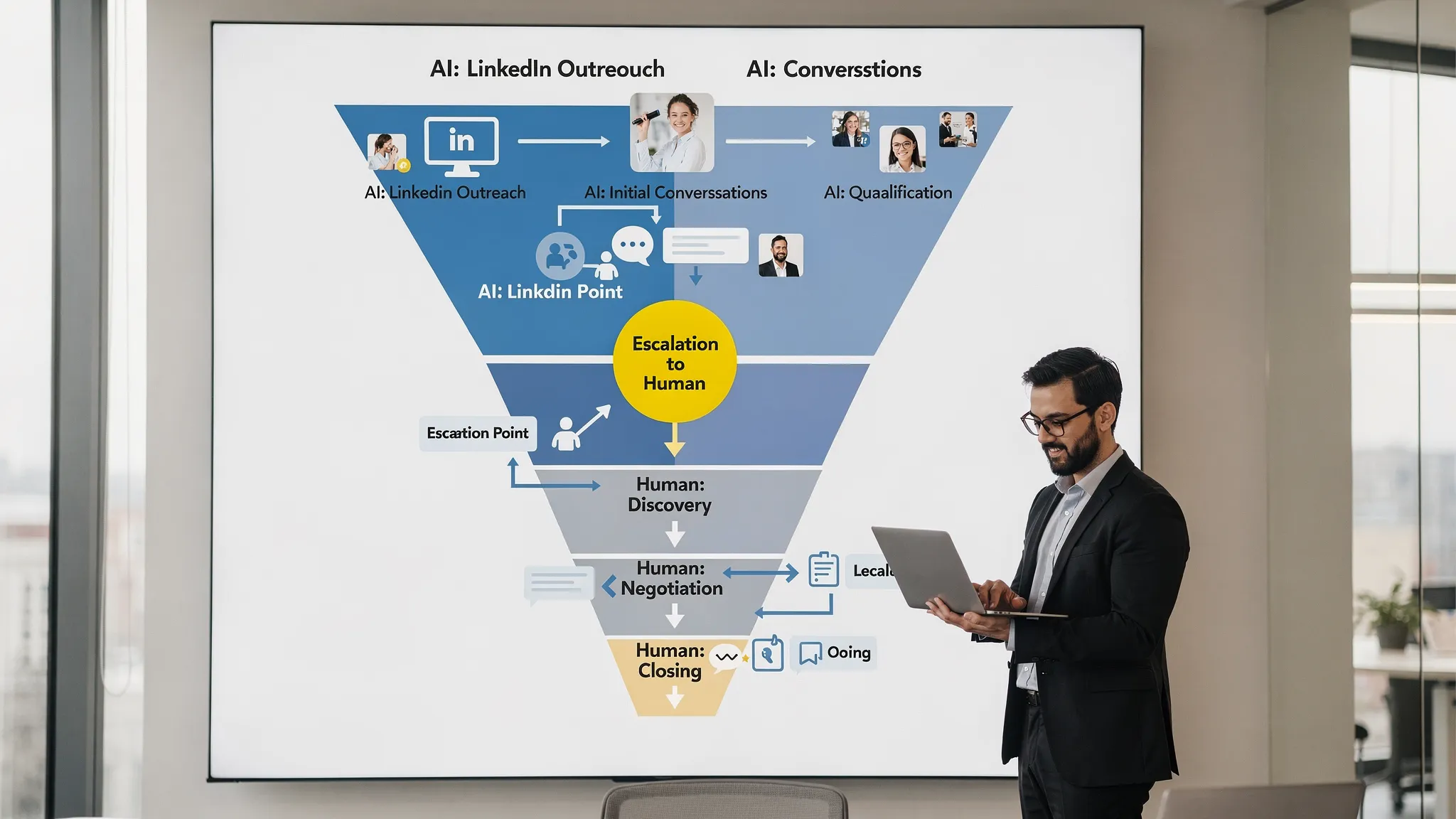
A practical framework: AI runs the thread, humans run the deal
The simplest way to operationalize AI and sales is to split work by stakes.
- Low-stakes, repeatable tasks: automate aggressively.
- High-stakes, high-context decisions: keep human-owned.
The table below makes that division concrete.
| Sales activity | AI can lead | Shared (AI + human) | Human must lead |
|---|---|---|---|
| Prospect research and summarization | Yes | Yes | Sometimes (strategic accounts) |
| First-touch outreach drafts | Yes | Yes (approve voice/claims) | Sometimes (exec-to-exec) |
| Managing follow-ups and keeping threads warm | Yes | Yes | Rarely |
| Capturing qualification signals consistently | Yes | Yes (review edge cases) | Sometimes (complex motions) |
| Discovery calls | No | Yes (prep, notes, next steps) | Yes |
| Negotiation and pricing | No | Limited (drafts, recap) | Yes |
| Forecast commitments | No | Yes (data support) | Yes |
| Coaching reps | No | Yes (insights) | Yes |
This structure lets you scale without pretending every step should be automated.
What “human-in-the-loop” should actually mean in modern sales
Many teams interpret human-in-the-loop as “a rep occasionally checks messages.” That is not enough. A useful definition is:
Humans control the system design, and humans take over when the stakes or ambiguity cross a threshold.
To make that real, you need three elements.
Clear escalation triggers
You want objective triggers that hand conversations to a human before damage happens.
Common triggers include:
- Buying intent (for example, “We are evaluating options this month”)
- Direct pricing or competitor questions
- Objections that imply reputation risk
- Requests to speak with a specific person
- Sensitive topics (legal, security, compliance)
Override control (not just “pause”)
A real override means a rep can:
- Take over a single thread instantly
- Adjust the tone and direction
- Decide whether to book, disqualify, or nurture
This is less about “saving time” and more about protecting outcomes.
Continuous improvement, not set-and-forget automation
AI in sales is an operating system, not a campaign. Humans must own:
- Prompt iteration
- A/B testing decisions
- Reviewing mis-qualifications
- Updating templates as market messaging shifts
If you are not running a feedback loop, you are not really adopting AI, you are renting it.
The new essential skills for sales teams using AI
AI does not eliminate skill, it changes where skill matters.
In practice, top performers increasingly differentiate through:
Conversation design and prompt quality
The prompt is your “sales process in words.” Humans need to encode:
- What counts as evidence
- Which questions are acceptable
- What the brand sounds like
- What the goal is at each stage (micro-conversions)
Judgment and triage
When AI handles more threads, human attention becomes a scarce resource. Skilled reps do not just respond fast, they respond to the right things.
Systems thinking
High-performing teams treat sales like an instrumented system:
- Define the stage
- Capture the signal
- Decide the next action
- Measure the downstream effect
This is the bridge between “activity” and “pipeline.”
Where Kakiyo fits (without removing the human from sales)
Kakiyo is built for a very specific reality: on LinkedIn, the conversation thread is the work. That makes it a strong channel for AI-led execution with human-led oversight.
At a high level, Kakiyo helps teams scale personalized LinkedIn conversations from first touch to qualification to meeting booking, while keeping humans in control through capabilities like:
- Autonomous LinkedIn conversations with personalization
- AI-driven lead qualification and an intelligent scoring system
- Customizable prompt creation, industry templates, and A/B prompt testing
- Simultaneous conversation management so you do not drop threads
- Conversation override control, plus a centralized real-time dashboard and analytics
The practical outcome is not “replace SDRs.” It is: let the system do the repetitive thread work, then route the best moments to humans.
If you want tactical guidance on running LinkedIn automation safely, this pairs well with Kakiyo’s guide on automated LinkedIn outreach. If you are evaluating categories, you can also compare approaches in Sales AI tools vs legacy sequencers.
A quick self-check: are you protecting human effort for the right moments?
Use this as a fast diagnostic. If you answer “no” to any of these, humans are likely spending time where AI should.
| Question | Why it matters |
|---|---|
| Do we have a written definition of qualified (with required evidence)? | Without this, AI scales noise and humans argue about quality. |
| Do we know which messages are allowed to be fully automated? | Prevents brand and compliance drift. |
| Do we have explicit escalation triggers? | Ensures humans step in when stakes rise. |
| Can reps override a thread instantly? | Protects buyer experience and prevents unforced errors. |
| Do we run prompt experiments and review outcomes weekly? | Keeps the system aligned with reality, not assumptions. |
Frequently Asked Questions
Will AI replace SDRs in 2026? AI is replacing a chunk of repetitive SDR tasks, especially drafting, follow-up, and thread management. SDRs who shift toward qualification judgment, account strategy, and high-skill conversations stay highly valuable.
What parts of sales should never be fully automated? High-stakes moments: discovery calls, negotiation, commercial commitments, and anything involving sensitive claims or compliance decisions should remain human-led.
How do we keep AI outreach from sounding generic? Humans need to define voice, value hypotheses, and acceptable personalization signals, then continuously test prompts and review real conversation outcomes.
How do you measure whether AI is helping or hurting sales quality? Track downstream metrics, not just replies: qualified conversation rate, meetings held, AE acceptance, meeting-to-opportunity conversion, and disqualification reasons.
What does “human-in-the-loop” look like for LinkedIn conversations? It means clear escalation triggers, the ability to override any thread instantly, and a continuous improvement loop for prompts, templates, and scoring.
Turn AI into leverage, not risk
If you want AI to handle LinkedIn conversations at scale while keeping humans focused on high-value opportunities, explore Kakiyo. It is designed to manage personalized outreach, qualify in-thread, and book meetings, with prompts, testing, scoring, analytics, and override control so your team stays in charge.